
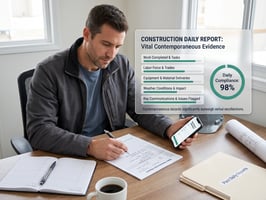
The daily report is the most underused legal protection in construction. When a dispute arises —...
 Payment disputes are the most common legal conflict in construction — and the most avoidable with the right systems. An owner who withholds payment because they dispute the quality of work, the scope of a change order, or the percent complete on a billing application isn't just an owner problem. It's a documentation problem. The contractor who can produce GPS-verified time records, photographed daily reports, signed T&M tickets, and a complete billing history has a fundamentally different position than the contractor arguing from memory and a handwritten invoice.
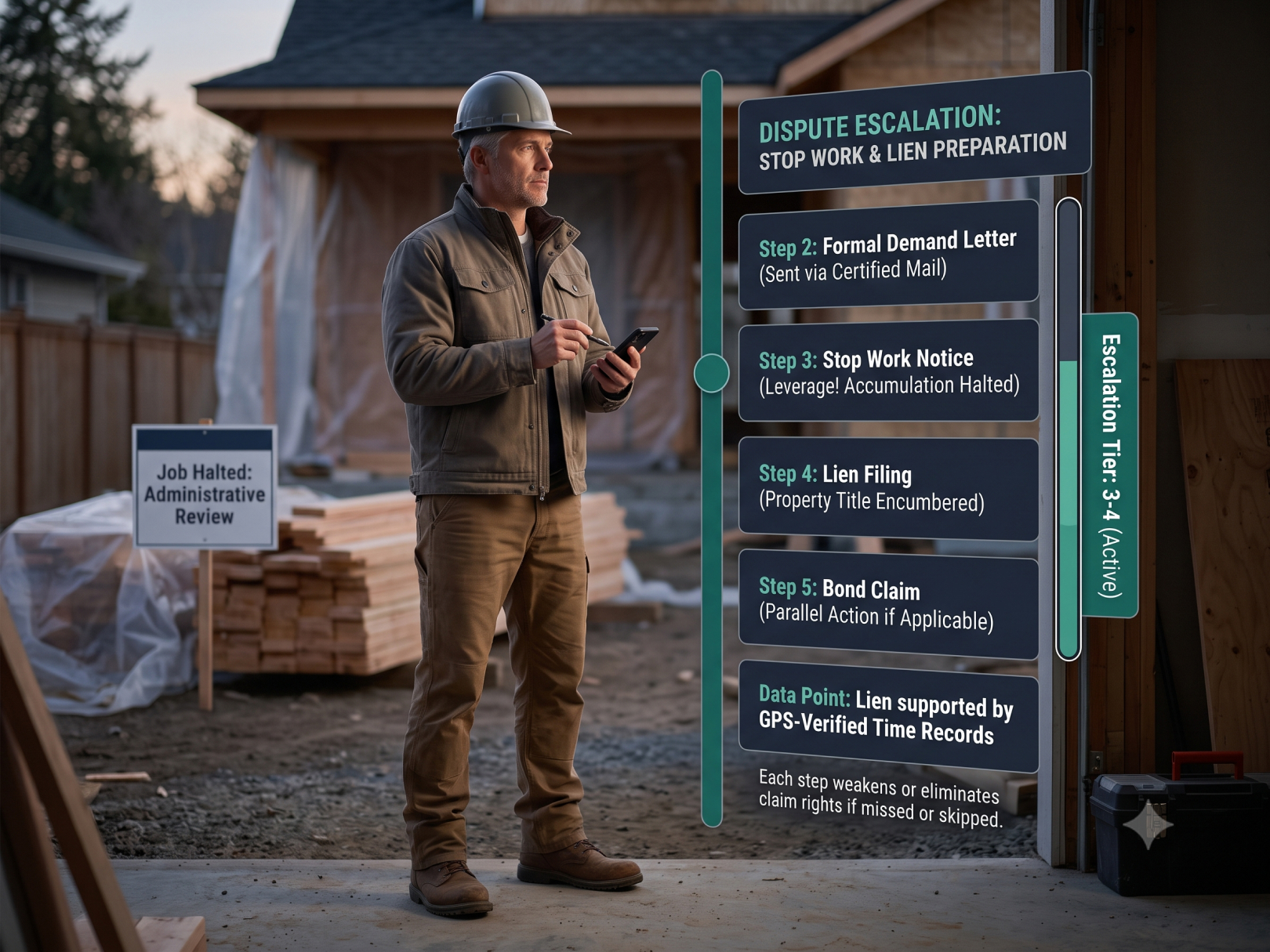
When prevention fails and a dispute escalates, the resolution path is a defined sequence: demand letter, stop work notice, lien, bond claim, and then dispute resolution — mediation, arbitration, or litigation depending on what the contract requires. Each step has specific requirements and timing. Skipping steps or missing deadlines weakens the claim or eliminates it entirely.
This guide covers why payment disputes happen, how to prevent them, the complete escalation sequence when they can't be prevented, and how construction time tracking software records are the evidentiary foundation for every step of a payment claim.
Why Payment Disputes Happen
.jpg?width=600&height=450&name=3%20(55).jpg)
Owner-side causes:
- Cash flow problems — the owner can't pay, not won't pay
- Change order disagreement — owner disputes scope, pricing, or authorization
- Quality dispute — owner claims work is defective and withholds proportionally
- Percent complete disagreement — owner believes less work is done than billed
- Retainage withholding beyond contract terms
- Owner insolvency — lender or investor pulled out, no money to pay
Contractor-side causes:
- Overbilling (claiming more percent complete than is accurate)
- Poor documentation — owner questions work that was performed but not documented
- Change orders executed without approval — owner refuses to pay for work they claim to know nothing about
- Contract compliance failures — missing submittals, late schedule updates, incomplete close-out documents used as payment-withholding justification
Most disputes involve both sides: An owner with cash flow problems finds documentation gaps to justify withholding, turning a liquidity problem into a scope dispute. Understanding the owner's actual motivation shapes the response strategy.
Contractors using project management software for general contractors can keep payment records, field updates, photos, and communication organized in one place so billing discussions are easier to support.
Prevention: Documentation That Wins Disputes Before They Start
The contractor who prevents payment disputes doesn't do so by choosing better owners — they do it by creating documentation that makes disputes unwinnable.
Payment application documentation: Every billing application should include:
- Schedule of values progress organized by cost code
- Photographs of completed scope for the billing period
- Sub invoices and lien waivers for billed subcontract work
- Change order log showing approved vs. pending COs
- Daily reports for the billing period
An owner who disputes a billing application that's backed by this documentation faces a documented record, not a contractor's assertion. Most legitimate disputes resolve at the payment application review stage when the documentation is complete.
Change order documentation: Every change order starts with a daily report entry the day the direction is given. Change order labor is tracked to a specific cost code via construction employee time tracking. T&M tickets are signed daily by the owner's representative. The paper trail makes change order disputes nearly impossible when maintained properly.
Time records as preemptive evidence: GPS-verified construction time tracking records show exactly who was on site, what dates, and how many hours — before any dispute arises. A contractor whose billing is supported by timestamped, GPS-confirmed labor records has documentary evidence the owner must specifically refute. An owner who claims "those workers weren't on my project that week" faces a digital record with location stamps.
This matters even more for specialty contractors with fast-moving field crews. For example, roofing photo documentation and crew tracking can help roofing contractors prove which crew was on site, what work was completed, and when the work happened.
If an owner claims workers were not on the project during a disputed week, GPS timesheets for contractors can support the contractor’s position with worker-level records, timestamps, and jobsite information.
The Payment Dispute Escalation Ladder
When payment stops, the response follows a defined sequence. Each step is more adversarial and more costly than the previous. Use the lowest effective step — but don't hesitate to escalate when lower steps fail.
1. Direct communication (phone + email) 2. Formal demand letter 3. Stop work notice 4. Lien filing 5. Bond claim (if project is bonded) 6. Prompt payment law claim (if applicable) 7. Dispute resolution — mediation → arbitration → litigation Step 1: Direct Communication
Before formal demand, a direct phone call confirms whether there's a processing delay, a specific issue with the invoice, or a deliberate withholding. Deliberate withholding without notice is unusual at this stage — most payment stops have an identifiable cause the owner will explain.
Document the call: Send a follow-up email the same day summarizing what was discussed, what the owner said, and what action they committed to. "As discussed in our phone call today, you indicated payment will be released by [date]." This documentation matters if the dispute escalates.
This follow-up email matters if the dispute escalates because it creates a dated written record of the conversation. Teams using TaskTag product features can keep project activity, field notes, photos, and updates easier to reference during payment conversations.
Step 2: Formal Demand Letter
When direct communication fails or produces no resolution within a reasonable period (7–14 days after payment was due), send a formal written demand.
Demand Letter Requirements
Format: Written, on company letterhead, sent by certified mail with return receipt requested AND by email. The certified mail receipt establishes delivery date — critical for subsequent steps.
The letter should be professional, factual, and direct. Avoid apology language or vague statements. If your team needs a better way to organize field records before disputes happen, best practices for managing construction projects can help strengthen documentation habits across the project lifecycle.
Content:
- Date
- Owner name and address
- Project identification
- Amount owed — specific: principal, any applicable interest under the contract or state law
- Basis for the amount — invoice numbers, contract reference, payment application numbers
- Demand for payment by a specific date (typically 7–14 days from letter date)
- Statement of intent to pursue all available remedies (liens, bond claims, legal action) if not paid
- No apology, no softening language — professional and factual
Sample demand letter structure:
[Date] [Owner Name] [Owner Address] Re: Payment Demand — [Project Name] Contract Amount: $[X] Amount Past Due: $[X] Invoice/Pay App Numbers: [X, X, X] Dear [Owner]: This letter constitutes a formal demand for payment of $[amount], representing [describe: retainage due, pay application #X dated [date], change orders #X-#X approved [date]], all of which are past due under the terms of our contract dated [date]. Payment is demanded within [7/14] days of this letter — by [specific date]. Failure to pay the above amount by [date] will result in [Contractor] pursuing all available remedies, including but not limited to filing a mechanic's lien, making a claim on the payment bond if applicable, and initiating legal proceedings. [Contractor] also intends to exercise its right to suspend work per [contract section] if payment is not received. This letter does not waive any rights [Contractor] may have under the contract, applicable law, or otherwise. Sincerely, [Contractor Name] [Signature] Step 3: Stop Work Notice
Most construction contracts give the contractor the right to stop work if payment isn't received within a specified number of days of the due date. The AIA A201 §14.1 allows the contractor to stop work with 7 days' written notice if the owner fails to pay properly.
When to use stop work:
- Payment demand has been sent and deadline has passed
- The amount in dispute is significant relative to ongoing work
- Continuing to work means accumulating more unpaid exposure
- The owner's financial condition is in question (see Owner Insolvency below)
What stop work requires:
- Written notice specifying the reason (non-payment) and the contract provision relied upon
- Specific date work will stop
- Certified mail delivery
What stop work does NOT mean:
- Abandonment of the project (abandonment without right creates contractor liability)
- Termination of the contract
- Waiver of any claims for the stopped period or lost productivity
Stop work has costs: Demobilization, remobilization, extended general conditions, potential delay claims from the owner. Weigh these costs against the benefit of stopping further unpaid exposure.
Stop work is most effective as leverage — many owners who ignored a payment demand respond immediately when the job site goes quiet.A construction management app for general contractors can help teams keep the project records, messages, and work history needed to support this decision.
Step 4: Lien Filing
Filing a mechanic's lien is the most powerful single-step tool available to a contractor with an unpaid claim. A lien encumbers the property title — blocking sale and refinancing until resolved.
File before the deadline. Lien deadlines are statutory and inflexible — missing them eliminates the right regardless of the claim's merit. See Construction Lien Rights for state-specific deadlines and filing procedures.
What construction time tracking app records do for lien claims:
The lien amount must be supported by evidence of labor performed. GPS-verified time records showing:
- Every worker who was on the project
- The exact dates they were present
- Total hours and corresponding labor cost
...create the evidentiary foundation that the claimed labor was actually performed at the claimed location during the claimed period. An owner who disputes the lien amount faces digital records they must specifically refute.
Lien + stop work together: Filing a lien while simultaneously stopping work maximizes pressure on the owner. The project stops, the title is encumbered, and the owner faces both operational and financial consequences of non-payment.A construction delivery tracking case study shows how organized coordination and delivery records can support better accountability on complex construction workflows.
Step 5: Bond Claim
On bonded projects — federally funded projects (Miller Act), many public projects, and some large private projects — the payment bond provides an alternative payment source when the owner or GC can't or won't pay.
Bond claims have their own deadlines — typically 90 days from last furnishing under the Miller Act for federal projects; state bond statutes vary. Bond claims require written notice to the principal (the GC, on a sub's claim) and the surety.
See Construction Bonds Guide for the complete bond claim procedure. File a bond claim whenever a project is bonded and payment stops — it runs parallel to the lien process, not instead of it.
Prompt Payment Laws
Most states have prompt payment laws that:
- Set maximum payment timelines (owner to GC, GC to sub)
- Require payment of undisputed amounts even when other amounts are disputed
- Impose interest (often 1–2% per month) on late payments
- May allow the contractor to stop work after specified non-payment periods
- Some states impose attorney fee shifting on the party who wrongfully withholds payment
Key provisions vary by state:`
- California: Owner must pay GC within 30 days; GC must pay sub within 7 days of receipt. Interest at 2%/month on late payments.
- Texas: Owner to GC within 35 days; GC to sub within 7 days. Interest at 1.5%/month.
- New York: Owner to GC within 30 days (public) / per contract (private); interest and attorney fees possible.
- Federal projects: Prompt Payment Act requires payment within 14 days of invoice approval.
Know your state's prompt payment law before drafting the demand letter — citing the applicable statute and statutory interest rate strengthens the demand and demonstrates you know your rights.Before a payment issue turns into a full dispute, contractors can start a free contractor account to begin organizing jobsite records, field communication, and project documentation in one place.
Dispute Resolution: Mediation, Arbitration, Litigation
When the above steps don't produce payment, the contract specifies the dispute resolution process.
Step 1: Review the Contract
AIA contracts require mediation before arbitration. Some custom contracts require negotiation before mediation. The sequence matters — skipping a required step may waive rights or procedural protections.
Most commercial construction contracts specify arbitration as the final dispute resolution method — not litigation. Arbitration is typically faster and cheaper than court but the decision is usually final with limited appeal rights.
Mediation
A neutral mediator facilitates negotiation between the parties — they don't decide the case. Mediation is confidential and non-binding. Success rate in construction disputes is high (60–70%) because both parties understand the cost and uncertainty of proceeding to arbitration or litigation.
Prepare for mediation with documentation:
- Complete payment history — what was billed, what was paid, what's outstanding
- Contract and all change orders
- Daily reports from the disputed period
- Time tracking records showing labor performed
- Photographs of work completed
- Lien notices filed
The mediator's job is to find common ground. Parties with better documentation have more ground to stand on.
Arbitration
If mediation fails, most construction contracts proceed to binding arbitration — typically administered by the American Arbitration Association (AAA) under its construction rules.
AAA Construction Arbitration:
- Claims under $75,000: Desk arbitration (no hearing) — decided on paper submissions
- Claims $75,000–$1M: One arbitrator, simplified hearing procedures
- Claims over $1M: Three-arbitrator panel, full evidentiary hearing
Filing fees are significant — $1,875 for a $75,000 claim, scaling up. Both parties typically pay their own attorney fees (no fee-shifting unless the contract or statute provides for it).
Time tracking records in arbitration: The arbitrator evaluates the evidence presented by both parties. GPS-verified contractor time tracking software records are presented as exhibits — they carry significant weight because they're contemporaneous, digital, and location-verified. An owner's attorney who challenges a contractor's labor claim faces an arbitrator who can see exactly who was on site, when, and for how many hours.
Litigation
When the contract doesn't require arbitration, or when the dispute involves fraud or criminal conduct, court litigation is an option. Construction litigation is expensive — attorney fees of $50,000–$300,000 are common on complex disputes. Reserve litigation for large claims or when arbitration isn't available.
Owner Insolvency: What to Do Immediately
When an owner's financial situation collapses — lender pulls funding, development entity goes bankrupt, owner stops communicating — the contractor's response must be immediate:
Stop all new credit extension. Don't continue purchasing materials or booking labor for a project where payment is doubtful. Each day of work is additional unpaid exposure.
File a lien immediately — don't wait for the demand letter process. When insolvency is suspected, lien deadlines are more urgent than ever. An unfiled lien against a bankrupt owner is a general creditor claim worth cents on the dollar. A recorded lien is a secured claim against the property.
Preserve all records. In bankruptcy proceedings, claims must be documented. Construction employee time tracking app exports, material invoices, and daily reports are the evidence supporting the claim value.
Consult a construction attorney immediately. Bankruptcy proceedings have automatic stays that may affect lien enforcement. An attorney experienced in construction insolvency navigates these rules and protects the contractor's position.
Common Payment Dispute Mistakes
.jpg?width=600&height=450&name=3%20(56).jpg)
Not sending a formal demand letter. A phone call is not a demand. A formal written demand starts the clock on the owner's response obligation, creates a documented record, and signals seriousness. Contractors who skip this step often find the dispute lingering for months because there's no formal record of the contractor's position.
Missing lien deadlines while waiting for the owner to respond. Lien deadlines don't extend because negotiations are ongoing. File the lien by the deadline regardless of negotiation status — the lien can always be released if the dispute resolves.
Continuing to work without payment. A contractor who keeps working while an owner is three months behind in payments is accumulating unpaid exposure on an owner who has already demonstrated they won't pay. Stop work is both a legal right and a financial necessity.
Not separating undisputed from disputed amounts. An owner who disputes a $15,000 change order isn't entitled to withhold $120,000 in undisputed base contract payments. Demand payment of undisputed amounts immediately — prompt payment laws often require this.
Inadequate documentation going into the dispute. Trying to reconstruct project records months after they were created is expensive and less credible than contemporaneous records. A contractor without construction time tracking for workers records, daily reports, and signed T&M tickets is arguing against an owner who can simply deny everything.
Mixing claims. Combining a payment dispute with change order claims, delay claims, and defect counterclaims in a single demand creates confusion and gives the owner more to respond to. Lead with the clearest, best-documented claim — typically unpaid approved contract work.
If your team wants a better way to organize field documentation, payment backup, and project communication, try TaskTag for 30 days free and start building stronger records before the next payment dispute happens.
Payment Dispute Response Checklist
Payment due date passes without payment:
- [ ] Confirm payment was properly submitted — correct format, address, contact
- [ ] Direct phone call to owner — document the conversation by email same day
- [ ] Wait 7 days maximum — then proceed to formal demand
Formal demand:
- [ ] Demand letter sent certified mail AND email — document delivery
- [ ] Demand specifies exact amount, basis, and deadline
- [ ] State prompt payment law cited if applicable
- [ ] Copy to attorney if amount is significant
If demand deadline passes:
- [ ] Stop work notice prepared — per contract requirements
- [ ] Lien deadline calculated and calendared — do not let this pass
- [ ] Lien filed if deadline approaching — regardless of negotiation status
- [ ] Bond claim filed if project is bonded
- [ ] Attorney engaged
Evidence assembled:
- [ ] Payment history — what was billed, what was paid, what's outstanding
- [ ] Time tracking records exported — GPS-verified hours by date and cost code
- [ ] Signed T&M tickets for change order work
- [ ] Daily reports for disputed period
- [ ] Photographs of completed work
- [ ] All change order documentation
Keep Payment Disputes From Becoming Documentation Problems
Track jobsite photos, time records, daily reports, and project communication in one place with TaskTag.
Related Resources
TaskTag Features
- GPS Time Tracking for Construction — GPS-verified labor records proving work was performed at the claimed location and dates
- Construction Time Tracking Software Guide — timestamped records that support payment dispute claims
- Time Tracking for Construction Workers — worker-level hour records as payment dispute evidence
- Top 5 Construction Time Tracking Apps — apps with exportable, audit-ready records for legal proceedings
- Top 5 BusyBusy Alternatives — time tracking alternatives with legally defensible record formats
- TaskTag vs. BusyBusy — payment dispute documentation comparison
Related Blog Posts
- Construction Bonds Guide — bond claims as payment dispute resolution on bonded projects
- Construction Retainage — retainage withholding disputes and prompt payment rights
- Construction Cash Flow Management — cash flow management during active payment disputes
- How to Negotiate a Construction Contract — dispute resolution clauses and stop work rights in contract negotiation
- Construction Project Delay — delay claims that accompany payment disputes
- Construction Defect Claims — owner defect counterclaims used to justify payment withholding
- Construction Project Closeout — final payment and retainage release at closeout
- Construction WIP Report — tracking disputed amounts in WIP position