
 A single uninsured job site accident can end a construction business. A worker falls from a scaffold and suffers a spinal injury — medical expenses alone can exceed $500,000. A subcontractor's equipment damages an adjacent building — repair and business interruption claims reach $300,000. A completed project develops water intrusion from improper waterproofing — the defect claim runs $180,000. Without the right insurance coverage at adequate limits, each of these scenarios is a personal financial catastrophe for the contractor.
Construction is one of the highest-risk industries for both worker injuries and third-party liability. Insurance premiums reflect that risk — but contractors who manage their risk proactively pay significantly less than contractors who don't. An Experience Modification Rate (EMR) of 0.80 vs. 1.20 on a $200,000 workers comp premium is $80,000 per year in difference. That gap comes from documented safety practices, accurate construction time tracking for workers comp audits, and a claims management approach that challenges questionable claims instead of accepting every filing.
This guide covers every coverage type a contractor needs, how premiums are calculated, what the audit process looks like, and how operational systems — including time tracking — directly affect what you pay.
General Liability Insurance
What It Covers
Commercial general liability (CGL) protects against third-party claims for:
- Bodily injury: An owner, visitor, or passerby is injured on or near your job site
- Property damage: Your operations damage a client's property or adjacent buildings
- Completed operations: A defect in completed work causes injury or damage after the project is finished. See Construction Defect Claims
- Personal and advertising injury: Libel, slander, copyright infringement in advertising
What It Does NOT Cover
- Employee injuries (covered by workers comp)
- Your own property or equipment (covered by inland marine or commercial property)
- Professional errors (covered by professional liability / E&O)
- Intentional acts
- Pollution (requires separate pollution liability coverage for contractors who work with hazardous materials)
Limits and Structure
Per occurrence limit: Maximum paid for a single claim. General aggregate limit: Maximum paid for all claims in a policy year. Products/completed operations aggregate: Separate limit for claims arising from completed work.
Standard commercial work minimum: $1M per occurrence / $2M aggregate Most large owners and GCs require: $2M per occurrence / $4M aggregate Design-build contractors: Often required to carry $5M+
Additional Insured Requirements
Clients and GCs routinely require being named as additional insured on your CGL policy. This gives them direct rights against your insurer for claims arising from your operations. Requirements to be named additional insured come in two forms:
- Primary and non-contributory: Your policy pays first, before the additional insured's own policy
- Waiver of subrogation: Your insurer waives the right to pursue the additional insured for reimbursement
Both requirements are standard in most construction contracts. Confirm your policy endorsements support these requirements before submitting a certificate of insurance that claims they do.
Premium Factors
- Trade classification (roofing vs. framing vs. painting — different risk profiles)
- Annual revenue
- Prior claims history
- Geographic market
- Type of work (residential vs. commercial, occupied vs. vacant)
Workers Compensation Insurance
Workers comp is the most complex and often most expensive insurance coverage for construction contractors — and the one most directly connected to payroll records from construction employee time tracking.
How Premiums Are Calculated
.jpg?width=600&height=450&name=3%20(49).jpg)
Premium = (Payroll by class code ÷ 100) × Rate per $100
Step 1: Payroll by class code. Every employee is assigned a workers comp class code based on their work duties. Class codes have different rates reflecting injury frequency and severity.
Step 2: Rates per $100 of payroll. Set by the state rating bureau (NCCI in most states) and adjusted for individual experience.
Step 3: Experience modification (EMR). Multiplied against the calculated premium. EMR above 1.0 increases premium; below 1.0 decreases it.
Sample calculation:
|
Class Code |
Trade |
Payroll |
Rate/$100 |
Premium |
|---|---|---|---|---|
|
5645 |
Framing carpentry |
$280,000 |
$14.20 |
$39,760 |
|
5537 |
HVAC |
$145,000 |
$9.80 |
$14,210 |
|
8227 |
Clerical |
$65,000 |
$0.45 |
$293 |
|
Subtotal |
$490,000 |
$54,263 |
||
|
EMR 0.85 |
×0.85 |
|||
|
Final premium |
$46,124 |
vs. the same payroll with EMR 1.20: $65,116 — a $19,000 annual difference.
Class Code Accuracy: The Audit Issue
Workers comp policies are issued on estimated payroll and adjusted at year-end in an annual audit. The audit compares estimated payroll to actual payroll — by class code — and adjusts the premium up or down.
The audit risk: If your actual payroll exceeds estimated payroll, you owe the difference at audit time — sometimes a large unexpected bill. If class codes are misapplied (workers doing high-rate work classified at low-rate codes), the auditor reclassifies them and you owe back premium.
How construction timesheet app data protects audit outcomes:
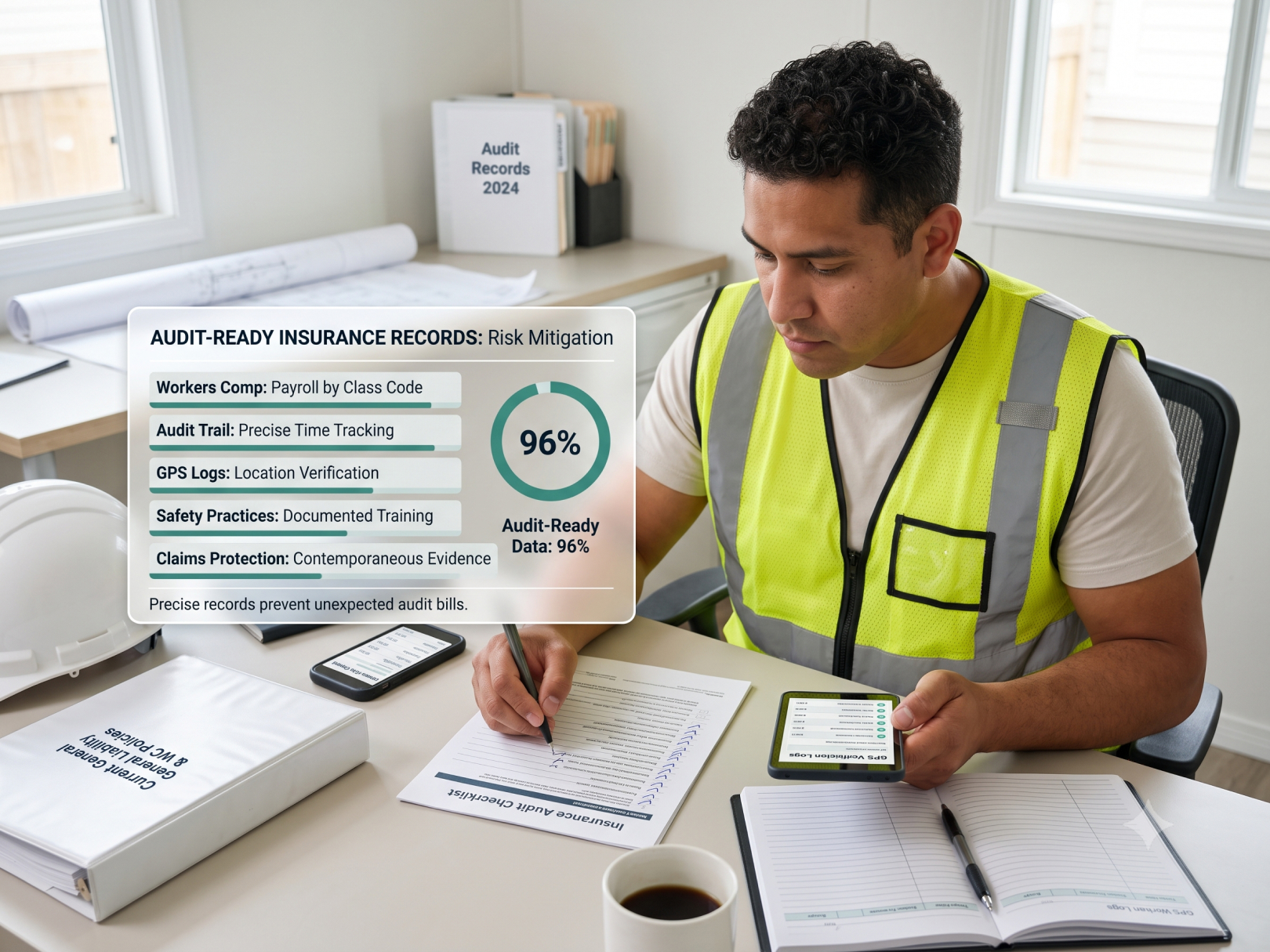
A time tracking system that captures trade classification at every clock-in produces an audit-ready payroll record:
- Hours by worker by trade class per week
- Total payroll by class code across the policy period
- GPS verification that workers were at job sites (not personal errands on company time)
- Clean records that match payroll tax filings exactly
An auditor who receives this data has nothing to dispute. An auditor reviewing handwritten timesheets with vague trade descriptions and inconsistent classification has reason to reclassify — and will, because reclassification almost always increases premium.
The Experience Modification Rate (EMR)
EMR measures your claims history relative to other contractors of the same size and trade. 1.0 is average. Below 1.0 means fewer/smaller claims than average — premium discount. Above 1.0 means more/larger claims — premium surcharge.
EMR is calculated from 3 years of claims history (excluding the most recent policy year). A single large claim affects your EMR for 4 years.
What drives EMR down:
- Fewer claims (prevention through safety programs)
- Smaller claims (early return-to-work programs that reduce lost time)
- Challenging fraudulent or inflated claims
What drives EMR up:
- Multiple claims in a policy year
- Lost-time claims (extended absence from work)
- Medical-only claims that become lost-time claims
EMR impact on bonding: Many bonding companies use 1.0 EMR as a threshold. Contractors above 1.0 may be declined or pay higher bond premiums. EMR above 1.25 often disqualifies contractors from public bidding. See Construction Bonds Guide.
Contesting Workers Comp Claims
Not all filed claims are legitimate — and even legitimate claims are sometimes inflated. Contractors who accept every claim without review pay higher premiums for years.
GPS time tracking records help contest questionable claims:
- Worker claims injury occurred Monday at the job site — GPS clock-in shows they weren't on site Monday
- Worker claims injury during specific hours — GPS records show they clocked out before the claimed injury time
- Worker claims to be unable to work — surveillance evidence combined with GPS records showing them at other locations
This isn't adversarial — it's financial protection. A falsified claim costs the contractor real premium dollars for years. Document everything, investigate promptly, and contest claims where the evidence doesn't support the claim.
Commercial Auto Insurance
Coverage
Commercial auto covers vehicles owned, leased, or regularly used for business:
- Liability (third-party bodily injury and property damage)
- Physical damage (collision and comprehensive on your vehicles)
- Hired and non-owned auto (employees using personal vehicles for work — critical coverage)
Hired and non-owned auto (HNOA): If an employee drives their personal vehicle to pick up materials and causes an accident, your company can be named in the lawsuit. HNOA covers this exposure. It's typically inexpensive to add to a commercial auto policy and essential for any company where employees use personal vehicles for work tasks.
Personal Vehicles for Business
Employees who regularly use personal vehicles for company business (picking up materials, driving to job sites, running company errands) should have their personal auto policy notified. Personal auto policies typically exclude business use. A gap between personal and commercial coverage leaves the company exposed.
GPS time tracking with mileage tracking clarifies which miles are business-related — supporting both the HNOA coverage position and IRS mileage deductions.
Builder's Risk Insurance
What It Covers
Physical loss or damage to the project under construction — the structure, materials, temporary structures, and often equipment used in construction. Perils covered typically include fire, theft, vandalism, wind, hail, and sometimes flood (check the exclusions carefully).
Who buys it: Either the owner or the GC — specified in the contract. If the contract is silent or requires the GC to provide it, it's a job cost.
Coverage period: From start of construction through substantial completion. Some policies extend through project closeout.
What Builder's Risk Does NOT Cover
- Design errors: If the structure fails because the design was wrong, builder's risk doesn't pay
- Faulty workmanship: Damage from the contractor's own defective work (though resulting damage to other parts of the structure may be covered)
- Equipment breakdown: Contractor's equipment is covered under inland marine, not builder's risk
- Earthquake and flood: Typically excluded — separate endorsements or policies needed in high-risk areas
Vacancy and Occupancy
Builder's risk policies usually exclude claims after the building is occupied. If a project phases with portions being occupied before full completion, notify the builder's risk carrier — the policy may need modification or a separate property policy may be needed for occupied areas.
Inland Marine (Tools and Equipment)
What it covers: Contractor's tools, equipment, and materials while in transit or at job sites. Builder's risk covers the project; inland marine covers your stuff.
Coverage options:
- Scheduled equipment: Specific pieces listed with individual values — accurate coverage, administrative burden
- Blanket coverage: All tools and equipment up to a total limit — simpler, may underinsure high-value equipment
What to insure:
- Heavy equipment (excavators, lifts, compressors)
- Smaller power tools above the deductible
- Materials stored at the job site (if not covered by owner's builder's risk)
- Mobile offices and storage trailers
Deductibles: Typically $500–$2,500 per occurrence. Small tool theft claims below the deductible aren't worth filing — they affect claims history without full reimbursement.
Professional Liability / Errors and Omissions
What it covers: Claims arising from professional services — design, engineering opinions, project management advice, or any work where you're providing professional expertise rather than just labor and materials.
Who needs it:
- Design-build contractors (providing design services)
- Contractors who provide engineering recommendations or stamped documents
- Construction managers providing fee-based management services
- Contractors who issue professional certifications (energy audits, accessibility compliance)
Who doesn't need it (typically): Pure labor-and-material contractors who build exactly what the A/E designed, with no design input.
Claims-made vs. occurrence: Professional liability is typically "claims-made" — coverage must be in force when the claim is filed, not just when the error occurred. Maintain coverage continuously; purchase "tail coverage" if you cancel the policy.
Employment Practices Liability (EPLI)
What it covers: Claims from employees alleging wrongful termination, discrimination, harassment, retaliation, or failure to hire/promote.
Construction relevance: As contractor headcounts grow and workforce diversity increases, EPLI exposure increases. A wrongful termination lawsuit from a fired employee — even a meritless one — costs $50,000–$150,000 to defend.
EPLI is underutilized in construction because contractors perceive themselves as too small or too informal to face this exposure. But small companies are more vulnerable — they rarely have HR policies, documented performance reviews, or consistent termination procedures that large employers use to defend against employment claims.
When you're considering terminating an employee — especially in sensitive circumstances — see How to Fire a Subcontractor for documentation principles that also apply to employee terminations.
Umbrella / Excess Liability
What it covers: Additional liability limits above the underlying GL, commercial auto, and employer's liability (workers comp) policies. When an underlying limit is exhausted, the umbrella picks up.
When you need it:
- Large project contracts requiring $5M+ combined limits
- Projects with significant bodily injury exposure (high-rise, occupied buildings, complex sites)
- Contractor revenue above $2M — exposure scales with revenue
- Any project where a single serious injury could exhaust your $1M GL limit
Cost: Typically $1,000–$5,000/year for $1M of umbrella coverage — inexpensive relative to the protection.
Certificate of Insurance Management
Every project requires you to produce certificates of insurance (COIs) naming the owner and/or GC as additional insured. Every sub you hire must produce COIs naming you.
Your COI management process:
- Request COIs from every sub before they start work — no exceptions
- Verify the COI covers the correct project period, trade, and limits
- Verify additional insured endorsement and primary/non-contributory language if required
- Track renewal dates — a sub's policy that expires mid-project leaves you unprotected
- Keep a COI file by project and by sub
Accepting expired COIs is a frequent construction insurance mistake. A sub who presents a COI dated 6 months ago may have had their coverage cancelled. Always check expiration dates and request updated COIs at renewal.
Common Coverage Gaps
|
Gap |
Risk |
Fix |
|---|---|---|
|
No hired/non-owned auto |
Employee personal vehicle accident names company |
Add HNOA endorsement to commercial auto |
|
Builder's risk not purchased |
Project fire or theft — no recovery |
Confirm contract responsibility; purchase if required |
|
GL excludes completed operations |
Post-completion defect claim — no coverage |
Verify completed operations aggregate in GL policy |
|
Workers comp class code errors |
Audit reclassification — unexpected premium |
Track trade classification at clock-in |
|
Subcontractor uninsured |
Sub's accident becomes GC's liability |
Verify COI before sub starts work |
|
Pollution excluded |
Hazardous material release — no coverage |
Add contractor's pollution liability if applicable |
|
Tools underinsured |
Job site theft — payout below replacement cost |
Update scheduled values annually |
Insurance Cost Reduction Strategies
.jpg?width=600&height=450&name=3%20(50).jpg)
Maintain a low EMR. Every dollar invested in safety and return-to-work programs pays back multiple times in reduced workers comp premium. An EMR decrease from 1.10 to 0.90 on a $100,000 workers comp premium saves $20,000/year.
Accurate payroll records for workers comp audit. Clean, classification-accurate payroll records from contractor time tracking software prevent adverse audit adjustments. Contractors whose records can't support their classifications pay reclassification surcharges.
Contest questionable claims promptly. Report every incident immediately — late reporting limits your ability to investigate. Engage a workers comp attorney for any claim that looks inflated or has inconsistencies with your GPS time records.
Bundle policies with one carrier. Multi-policy discounts of 5–15% are common. GL, commercial auto, inland marine, and umbrella bundled with one carrier typically costs less than placing each separately.
Higher deductibles on inland marine. Small tool claims below $2,000 aren't worth the premium increase from filing. Take a higher deductible, absorb small losses, and reserve insurance for significant losses.
Annual policy review. Coverage needs change as the company grows. A contractor who bought $1M GL at $500K revenue and is now at $3M revenue is underinsured. Annual review with your broker ensures coverage scales with the business.
Insurance Checklist for Contractors
Required before first project:
- [ ] Commercial general liability — minimum $1M/$2M
- [ ] Workers compensation — before first employee
- [ ] Commercial auto — all company vehicles; HNOA endorsement
- [ ] Builder's risk process established
Recommended:
- [ ] Inland marine (tools and equipment)
- [ ] Umbrella/excess liability — $1M minimum
- [ ] EPLI (when headcount exceeds 5 employees)
- [ ] Professional liability (if any design services provided)
Ongoing management:
- [ ] COI received from every subcontractor before work starts
- [ ] Sub COI renewal dates tracked
- [ ] All incidents reported to insurer within 24 hours
- [ ] Annual policy review with broker
- [ ] Workers comp audit preparation — time tracking records organized by class code
Related Resources for Contractors
If you are improving risk management and field documentation, these resources can help.
Use GPS timesheets for contractors to keep cleaner payroll and jobsite records.
Explore construction management tools and features that help contractors organize field activity and project documentation.
Read the construction project management guide to improve scheduling, communication, budgets, and documentation.
Compare documentation options in the TaskTag vs CompanyCam comparison if your team needs better jobsite photos and project records.
Learn more about TaskTag and how it supports contractor workflows.
You can also visit the construction management resources library for more guides.
Related Resources
TaskTag Features
- GPS Time Tracking for Construction — trade classification tracking at clock-in for workers comp audit accuracy
- Construction Time Tracking Software Guide — payroll records that satisfy workers comp audits and support claim defense
- Time Tracking for Construction Workers — hourly records by trade class for accurate workers comp classification
- Top 5 Construction Time Tracking Apps — apps with trade classification and audit-ready payroll export
- Top 5 BusyBusy Alternatives — time tracking alternatives for workers comp audit compliance
- TaskTag vs. BusyBusy — workers comp audit documentation comparison
Related Blog Posts
- Construction Bonds Guide — EMR impact on bonding capacity and public bidding eligibility
- Construction Defect Claims — completed operations coverage and defect claim defense
- Construction Project Closeout — insurance documentation at project closeout
- How to Negotiate a Construction Contract — additional insured, waiver of subrogation, and insurance clause negotiation
- Contractor Profit and Loss Statement — insurance costs in overhead calculation
- Construction Cash Flow Management — workers comp audit payment as a cash flow planning item
- How to Fire a Subcontractor — EPLI-related documentation when terminating employees or subs


.jpg?height=200&name=2%20(59).jpg)