

The US construction industry added over 200,000 new contractor businesses in 2024 — and residential renovation spending remains above $500 billion through 2026. The opportunity is real. But 68% of new construction businesses fail within 5 years — not from lack of work, but from pricing errors, cash flow gaps, and missing systems.
Key Takeaways
- 68% of new construction businesses fail within 5 years — mostly from pricing errors and missing systems, not lack of demand
- Licensing requirements vary by state and trade — verify before accepting any paid work
- The first 6 months are setup months: legal structure, insurance, and pricing before scaling marketing
- 70% of first-year clients come from personal network and referrals — not paid advertisin
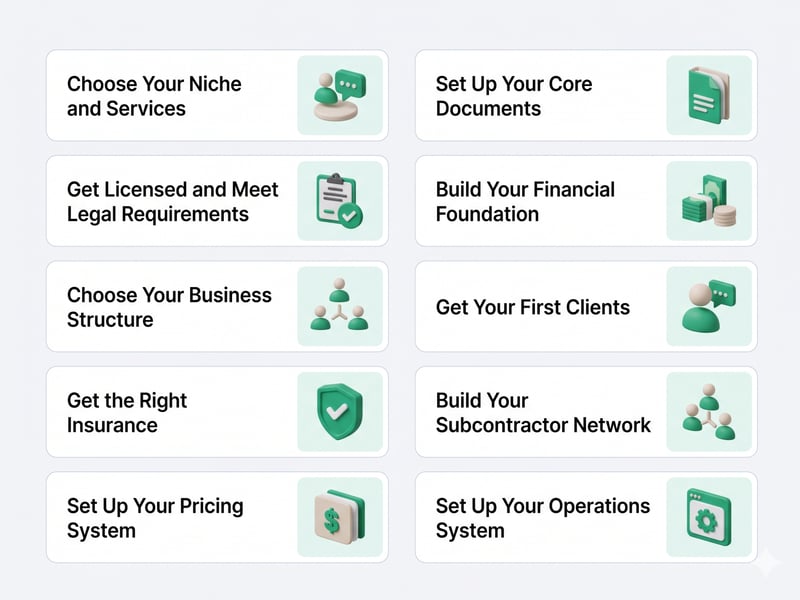
Step 1: Choose Your Niche and Services
The most common startup mistake is trying to do everything. Specialists grow faster, build stronger referral networks, and charge higher prices than generalists at the same experience level.
Define before registering:
- Trade/project type — kitchens, baths, roofing, electrical, ADU, aging-in-place
- Geography — realistic 30–45 min service radius
- Target project size — your sweet spot determines everything from marketing to hiring
Step 2: Get Licensed and Meet Legal Requirements
Working without the required license is a criminal offense in most states.
|
License Type |
Who Needs It |
|
General contractor license |
GCs managing full projects |
|
Specialty trade license |
Electricians, plumbers, HVAC, roofers |
|
Home improvement registration |
Many residential remodelers |
|
Business license |
All businesses |
Research your state's contractor licensing board before accepting paid work. Most states require a bond ($5,000–$25,000), documented experience (2–4 years), and sometimes an exam.
Step 3: Choose Your Business Structure
Form an LLC. The liability protection alone is worth the $50–$500 filing fee.
|
Structure |
Liability Protection |
Best For |
|
Sole proprietorship |
None |
Not recommended for contractors |
|
LLC |
Yes |
Most new contractors |
|
S-Corporation |
Yes |
$80K+ annual net profit |
LLC setup: file Articles of Organization → get federal EIN (free at http://IRS.gov ) → open a dedicated business bank account → register for state taxes.
Once annual net profit consistently exceeds $80,000–$100,000, an S-Corp election can save $8,000–$15,000/year in self-employment taxes.
Step 4: Get the Right Insurance
A single uninsured job site accident can end a new business.
Required coverage:
- General Liability — $1M per occurrence minimum; clients require a cert before you start ($1,500–$4,000/year)
- Workers' Comp — required before any hire; some states require it for sole proprietors
- Commercial Auto — personal auto excludes commercial use
- Tools and Equipment — covers theft and damage at job sites
Optional: Builder's risk (per project), umbrella policy, professional liability for design-build work.
Step 5: Set Up Your Pricing System
Pricing failure is the #1 cause of contractor business failure. Most new contractors underprice by forgetting overhead, insurance, taxes, and unbillable time.
Job Price = Direct Costs + Overhead Allocation + Profit Margin
Direct Costs = Fully loaded labor + Materials + Subs + Equipment
Fully Loaded Labor = Wage × (1 + burden rate)
Burden Rate ≈ 28–35% (FICA + workers' comp + benefits + vacation)
Overhead Allocation = Annual overhead ÷ Annual billable hours
Target net margins: Specialty trades 15–25% | Remodel GC 10–18% | New construction GC 8–15%
Markup ≠ Margin: 20% markup on $10,000 = $12,000 = 16.7% margin. 20% margin = $12,500. Know which you're calculating.
For the complete framework, see our how to estimate construction costs guide.
Step 6: Set Up Your Core Documents
Before your first paid job, have these four ready:
- Scope of work template → construction scope of work template
- Proposal / contract template → how to write a construction proposal + construction contract template
- Invoice template → contractor invoice template
- Change order template → construction change order template
These four documents prevent the disputes and unpaid invoices that kill new contractor businesses in year one.
Step 7: Build Your Financial Foundation
Always collect a 25–30% deposit before starting any job. Never start without a signed contract and deposit in hand.
Key rules:
- Structure draws to match costs — don't front-load expenses and back-load payments
- Separate business and personal finances from day one
- Build a 3-month operating reserve before scaling marketing
- Track estimated vs. actual costs on every job — most new contractors discover their labor estimates are 20–30% off in year one
Step 8: Get Your First Clients
Your first 5–10 clients will come from your personal network — not marketing.
- Contact 50 people in your network — family, former coworkers, neighbors
- Offer a launch rate (10–15% off) on first 3 jobs for a review and referral permission
- Set up Google Business Profile on day one — highest-ROI free marketing action
- Ask for referrals explicitly after every completed job
- Join local trade networks — NAHB chapters, AGC, local chamber
Referrals close at 3–5x the rate of cold leads. Build the habit early.
Step 9: Build Your Subcontractor Network
Before your first job, identify and vet one reliable sub for each trade you'll commonly need: electrical, plumbing, HVAC, concrete, painting. Check licenses, verify insurance, do a small job together before relying on them for a large one.
See our how to manage subcontractors guide.
Step 10: Set Up Your Operations System
|
Function |
Minimum Setup |
|
Estimates |
Spreadsheet template or estimating software |
|
Proposals / contracts |
Templated documents |
|
Scheduling |
PM software or shared calendar |
|
Daily job logs |
Daily report template |
|
Invoicing |
QuickBooks, Wave, or similar |
Log every job every day. Track job profitability from the start. See our construction daily report template and best construction project management software guide.
Relevant Article:Landscaping Construction Jobs: Your Complete Career & Business Guide for 2026
Startup Checklist
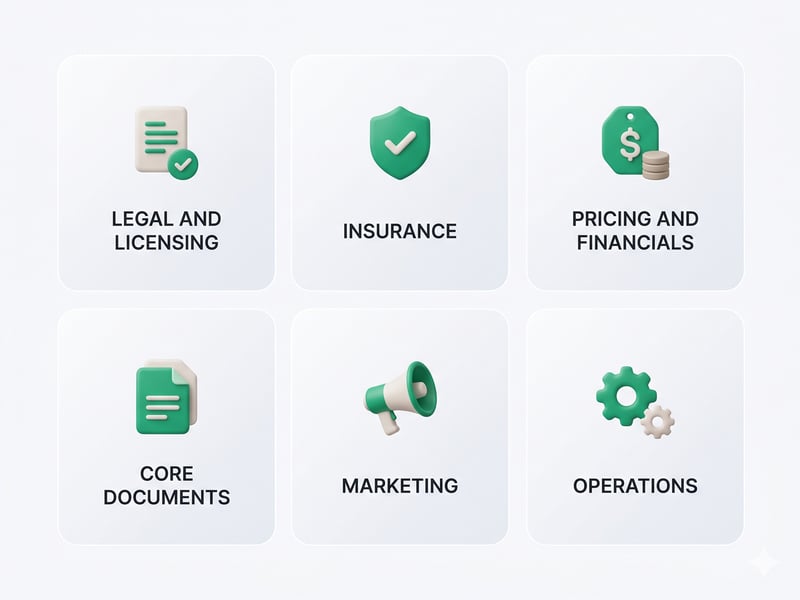
LEGAL AND LICENSING
☐ Research state/local licensing for your trade
☐ Apply for contractor license (exam, experience docs, bond)
☐ Form LLC + get EIN
☐ Open business bank account
☐ Register for local business license
INSURANCE
☐ General liability ($1M minimum)
☐ Commercial auto
☐ Tools and equipment
☐ Workers' comp (before hiring)
PRICING AND FINANCIALS
☐ Calculate fully loaded labor rate
☐ Calculate annual overhead
☐ Set margin targets by project type
☐ Open business savings account
CORE DOCUMENTS
☐ Scope of work template
☐ Proposal / contract template
☐ Invoice template with payment terms
☐ Change order template
☐ Lien waiver templates
MARKETING
☐ Google Business Profile (fully completed)
☐ Business cards
☐ Personal network outreach (50 contacts)
OPERATIONS
☐ Estimating template built
☐ PM tool selected
☐ Daily report process defined
☐ Subcontractor network identified
Sources: BLS Business Employment Dynamics 2024 · Harvard JCHS LIRA 2026 · NAHB Remodeling Market Survey 2025 · AGC Contractor Business Survey 2024
.jpg?height=200&name=1%20(53).jpg)