

Cost codes are the foundation of every meaningful financial measurement in construction. Without...

Construction cost overruns average 28% above original estimates (McKinsey, 2023). Inaccurate estimates aren't just frustrating — they're the leading cause of contractor insolvency. A job priced at a $12,000 gross profit that delivers a $4,000 loss consumes the profit from the next two jobs.
Key Takeaways
- Cost overruns average 28% — driven primarily by estimating errors, not unforeseen conditions (McKinsey, 2023)
- A complete estimate has 5 cost categories: direct labor, materials, subcontractors, equipment, and indirect costs
- Material costs rose 5–7% YoY and labor 4% YoY in 2026 — old unit prices will underprice every job
- The most common error: forgetting indirect costs (supervision, cleanup, permits, mobilization)
Why Most Construction Estimates Are Too Low
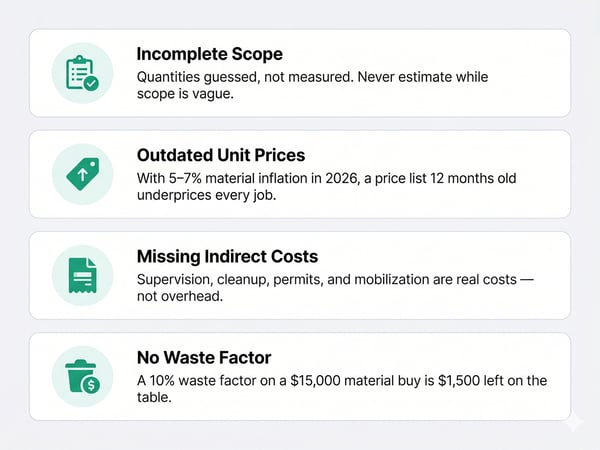
Underestimating is usually optimism combined with an incomplete system. The four most common sources of error:
- Incomplete scope — Quantities guessed, not measured
- Outdated unit prices — With 5–7% material inflation in 2026, a price list 12 months old underprices every job
- Missing indirect costs — Supervision, cleanup, permits, and mobilization are real costs — not "overhead"
- No waste factor — A 10% waste factor on a $15,000 material buy is $1,500 left on the table
Our finding: The line item most consistently missing from small contractor estimates is the GC's own supervision time. A contractor spending 15 hours/week on a 10-week project has 150 hours at $85–$95/hr — that's $12,750–$14,250 in cost. When it's not in the estimate, it comes out of profit.
For how estimating accuracy affects overall business profitability, see our house renovation business plan guide — the financial section covers markup structures and margin benchmarks by contractor type.
The 5 Cost Categories Every Estimate Must Include
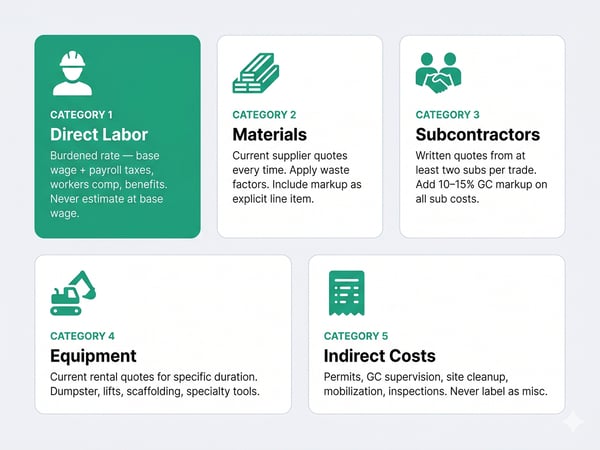
Category 1: Direct Labor
Labor Cost = (Hourly wage × burden rate) × hours required
Burden rate includes:
- Payroll taxes (FICA): ~7.65%
- Workers' compensation: 5–25% (varies by trade)
- General liability allocation: 2–5%
- Benefits: 10–20%
- Total burden: typically 30–50% above base wage
Example:
- Carpenter base wage: $32/hr | Burden: 38% | Burdened rate: $44.16/hr
- Rough framing: 80 hours → $3,533 labor cost
Never estimate labor at base wage. On a $200,000 project with 800 labor hours, forgetting a 38% burden rate is $28,000 in costs priced as profit.
Category 2: Materials
Get current supplier quotes every time for jobs over $5,000 in materials. Don't use historical averages on active bids.
|
Material |
Quantity Method |
Waste Factor |
|
Lumber (framing) |
Linear feet from plans |
+15% |
|
Drywall |
Sq ft of wall/ceiling |
+10% |
|
Tile |
Sq ft of floor/wall |
+10–15% |
|
Paint |
Sq ft ÷ coverage rate |
+10% |
|
Trim/millwork |
Linear feet from plans |
+10% |
Material markup: 10–25% above cost to cover procurement, storage, handling, and waste risk. Include it as an explicit line item.
Category 3: Subcontractors
Get written quotes from at least two subs per trade before finalizing the estimate.
|
Trade |
Quoted Price |
Quote Date |
Scope Included |
|
Electrical |
$4,200 |
Apr 22, 2026 |
Rough + finish, addition zone |
|
Plumbing |
$3,800 |
Apr 21, 2026 |
Rough + finish, kitchen + bath |
|
Tile |
$2,400 |
Apr 22, 2026 |
Kitchen floor, master bath |
Your markup on sub costs: 10–15%. The GC bears liability for all sub work and manages their coordination — that has real cost.
For vetting subs before committing their quote to an estimate, see our how to manage subcontractors guide.
Category 4: Equipment
Get current rental quotes for the specific duration needed. Common items:
- Dumpster rental: $350–$600/week
- Scissor/boom lift: $250–$600/day
- Scaffolding: $150–$400/week
- Specialty tools: $25–$75/day
Category 5: Indirect Costs (Most Often Forgotten)
|
Cost Item |
Typical Range |
|
Permits and fees |
$200–$5,000+ |
|
GC supervision time |
$85–$110/hr × actual hours |
|
Project management |
5–10% of direct costs |
|
Site cleanup (ongoing) |
$300–$800/week |
|
Temporary utilities |
$50–$300/month |
|
Mobilization / demob |
$500–$2,000 |
|
Inspection fees |
$100–$500 per inspection |
|
Material delivery costs |
$100–$400 per delivery |
|
Insurance allocation |
1.5–3% of revenue |
Add every applicable indirect cost as an explicit line item. "Misc" is not an estimating category — it's where profit goes to die.
The Markup Formula: How to Price for Real Profit
Most contractors use the wrong formula.
WRONG — cost-plus markup:
$40,000 costs × 1.20 = $48,000 price
Gross margin = $8,000 / $48,000 = 16.7% (NOT 20%)
CORRECT — margin formula:
Price = Direct costs ÷ (1 − desired margin)
$40,000 ÷ (1 − 0.20) = $50,000 price
Gross margin = $10,000 / $50,000 = 20% ✓
Target Gross Margin by Business Stage
|
Gross Margin |
Status |
|
Below 20% |
Not a viable business |
|
20–25% |
Survival — covers overhead with little cushion |
|
25–30% |
Healthy — NAHB average for established contractors |
|
30–35% |
Strong — best-in-class residential |
|
35%+ |
Premium — specialty/high-end differentiated work |
NAHB data shows average remodeling companies achieve 24.9% gross / 4.7–8.7% net margin (NAHB, 2023).
The Construction Cost Estimate Template
CONSTRUCTION COST ESTIMATE
Project: _______________________ Date: __________
Client: ________________________ Valid for: 30 days
════════════════════════════════════════════
- DIRECT LABOR
Task Hours Burdened Rate Total
Framing ___ $______/hr $______
Supervision ___ $______/hr $______
Cleanup ___ $______/hr $______
LABOR SUBTOTAL: $______
- MATERIALS (waste factors applied)
Item Qty Unit Unit Cost Waste Total
_______ ___ ___ $______ +___% $______
_______ ___ ___ $______ +___% $______
Material markup (____%): $______
MATERIALS SUBTOTAL: $______
- SUBCONTRACTORS
Trade Company Quote Date Cost
Electrical ___________ ________ $______
Plumbing ___________ ________ $______
Sub markup (____%): $______
SUBCONTRACTOR SUBTOTAL: $______
- EQUIPMENT
Dumpster ___ days $______/wk $______
Rentals ___ days $______/day $______
EQUIPMENT SUBTOTAL: $______
- INDIRECT COSTS
Permits and fees $______
Supervision (GC time) $______
Mobilization / demob $______
Inspections $______
Delivery costs $______
INDIRECT COSTS SUBTOTAL: $______
════════════════════════════════════════════
TOTAL DIRECT COSTS: $______
OVERHEAD (___% of revenue): $______
PROFIT TARGET (___% gross margin): $______
CONTRACT PRICE: $______
════════════════════════════════════════════
Gross margin check: Profit ÷ Price = ___%
(Target ≥ 25% for residential work)
Step-by-Step Estimating Process
- Complete the scope first. Never estimate while scope is vague. Use allowances for unmade material selections — document them explicitly.
- Visit the site. Site access, existing conditions, ceiling heights, and staging distance all affect cost. Visit before you quote.
- Measure, don't guess. Count every door, measure every wall, calculate every square foot. For larger projects, use estimating software for digital quantity takeoff. See our AI construction estimating software guide for tools that automate this.
- Get current quotes. Call subs and suppliers every time for jobs over $25,000.
- Build bottom-up. Direct costs → indirect costs → overhead → profit margin. Never work top-down from a client budget.
- Review for missing items. Walk the scope mentally from day 1 through punch list. What do you need at each stage? Every activity requires people, materials, or equipment.
- Add contingency. For renovation projects where walls will be opened: 10–15% contingency for unforeseen conditions. Present it as an explicit line item — clients who understand construction expect it.
How to Present the Estimate to the Client
Show major line items — not every sub-line, but not a lump sum either.
Present: Labor (total), Materials (by category), Subcontractors (by trade), Permits and fees, Contingency.
Don't show your overhead percentage or profit line — those are internal.
Include inclusions and exclusions. This becomes the foundation of your contract scope. See our construction contract template — the scope section mirrors your estimate's inclusions and exclusions directly.
Add a validity period. With 5–7% annual material inflation, an estimate is only valid for 30 days. State it on the document.
Connect milestones to payment. Show how the payment schedule ties to project phases. See our contractor invoice template for the payment structure that integrates with your estimate.
Relevant Article:How Smart Selection Tracking Prevents Costly Construction Mistakes
Frequently Asked Questions
How accurate does a construction estimate need to be?
Target within 10% of actual cost. Detailed bottom-up estimates with a site visit achieve 76% accuracy within 10% — compared to 18% for gut-feel pricing. Every 1% of estimating error on a $100,000 project is $1,000 in margin.
What is an allowance in a construction estimate?
A budget placeholder for scope where the final selection hasn't been made. Example: "Tile allowance: $8/sq ft installed." If the client selects $12/sq ft tile, the difference is a change order. See our construction change order template for handling allowance overages.
How do I estimate when I can't see behind the walls?
Add a 10–15% contingency line item for unforeseen conditions and document it explicitly. Common discoveries in older homes: knob-and-tube wiring, galvanized plumbing, asbestos, lead paint, structural issues. Your contract should include a change order provision for unforeseen conditions. See our construction contract template for that clause.
Should I use estimating software or spreadsheets?
Both work — discipline matters more than the tool. Spreadsheets are sufficient for smaller projects. Dedicated software (Buildertrend, Buildxact) adds speed and unit price databases. For projects above $50,000 or 3–4 estimates/month, software pays for itself. See our AI construction estimating software guide for a full comparison.
How do I handle a client who says my estimate is too high?
First, verify you're comparing the same scope — the most common reason a client thinks your price is high is that the competing quote doesn't include the same work. Ask to see the other scope. If scopes are identical, explain your price, offer to reduce scope, or decline. Never reduce your margin to match a competitor who priced below cost. The industry average net margin is 4.7–8.7% — there's very little room to discount.
Conclusion
Accurate estimating is the foundation of every other business system. A price that doesn't cover costs makes your schedule irrelevant, your contracts unenforceable in practice, and your cash flow a constant crisis.
Build every estimate bottom-up from current prices. Visit the site. Price every indirect cost as a line item. Use the margin formula, not the markup formula. Update your unit prices quarterly.
For the full contractor toolkit, see our construction contract template for turning your estimate into a binding agreement, our construction project schedule for aligning your timeline to the work you've estimated, and our AI construction estimating software guide for tools that automate the most time-consuming parts of the process.
Sources: McKinsey Global Institute 2023 · NAHB/Eye on Housing 2023 · Block Renovation 2026 · FMI/Autodesk Construction Disconnected 2023
.jpg?height=200&name=1%20(99).jpg)