
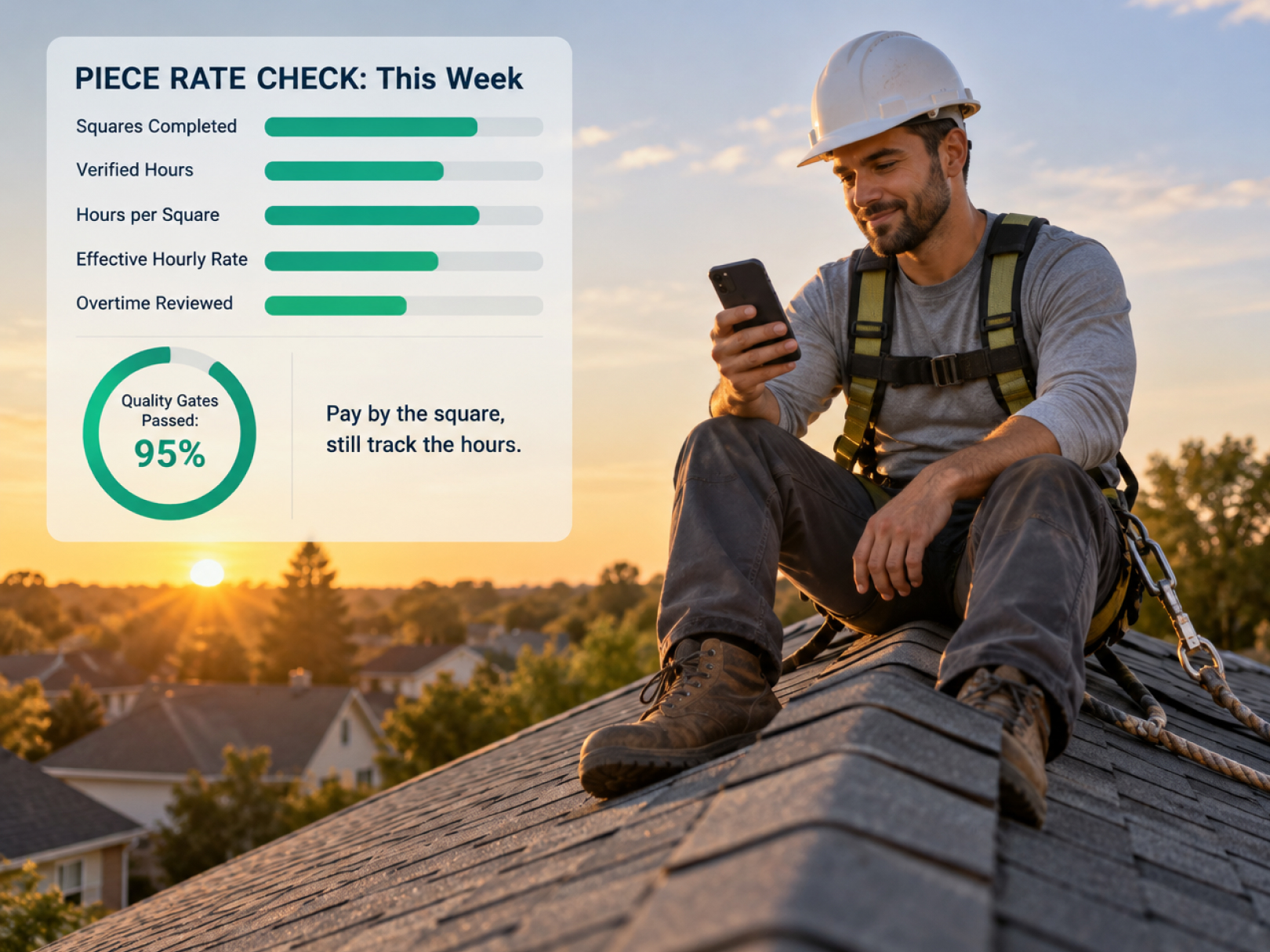
 Roofing is one of the few trades where pay per square is still common, and it solves one problem while creating three others. Paying by the square rewards speed and keeps labor cost predictable on a bid. It also tends to push crews toward rushed flashing, skipped details, and callbacks, and it creates record-keeping and overtime obligations that many roofing owners do not realize apply to them.
This guide compares pay per square, hourly pay, and hybrid models for roofing crews. It covers how each affects cost, quality, and risk, why you still need time records under a piece-rate system, and how to set up tracking so the pay structure does not become a legal or financial problem. It supports the day-to-day management covered in the roofing project manager role guide.
This is operations guidance, not legal advice. Wage and hour rules, including piece-rate overtime and worker classification, vary by state and by situation. Review your pay plan with an employment attorney or payroll compliance specialist.
The Three Common Pay Models
Most roofing companies use one of these, or a mix.
- Pay per square (piece rate). A crew or worker earns a set amount per square installed, such as a flat rate for tear-off and a rate for shingle install. Pay depends on output.
- Hourly. Workers are paid by the hour, with overtime where required. Pay depends on time worked.
- Hybrid. A base hourly wage plus a production bonus, or hourly pay with per-square incentives above a target. Pay depends on both.
A fourth arrangement, paying crews as independent subcontractors by the square, appears often in roofing. It raises separate classification questions covered later.
How Each Model Affects Cost and Quality
The pay model changes behavior. Plan for what it will push crews to do.
|
Factor |
Pay per square |
Hourly |
Hybrid |
|---|---|---|---|
|
Labor cost predictability |
High |
Medium |
Medium to high |
|
Speed incentive |
Strong |
Weak |
Moderate |
|
Quality incentive |
Weak, unless tied to inspections |
Moderate |
Moderate to strong |
|
Callback risk |
Higher if poorly managed |
Lower |
Lower with quality gates |
|
Handling hidden damage |
Conflict-prone, since extra work slows output |
Simple |
Manageable |
|
Cleanup and detail work |
Often rushed |
Paid for time |
Paid for time |
|
Safety pressure |
Higher, since speed pays |
Lower |
Moderate |
|
Admin burden |
Quantity measurement plus time records |
Time records |
Both |
|
Overtime compliance |
Needs careful calculation |
Straightforward |
Needs calculation |
|
Crew morale |
High for productive crews |
Depends |
Often good |
Pay per square works well on simple, repeatable roofs. It strains on complex roofs with many valleys, steep pitches, repairs, or tear-off surprises, where output per hour drops and crews feel punished for conditions outside their control.
Where Pay Per Square Goes Wrong
These are the failure modes owners report most often.
- Rushed details. Flashing, pipe boots, and valleys take time and pay the same as a flat field. Crews hurry through them.
- Hidden damage disputes. Replacing rotted decking slows the crew. Without a separate rate, they resent it or skip it.
- Cherry-picking jobs. Crews prefer easy roofs and avoid hard ones.
- Safety shortcuts. Faster is paid better, so fall protection and ladder setup get skipped.
- Callbacks hidden in the pay model. The crew is paid on install, and the callback cost lands on the owner.
- Cleanup neglected. Magnetic sweeps and debris cleanup do not count as squares.
- Hours disappear. Without time records, nobody knows how long jobs really take, which breaks estimating.
- Compliance gaps. Piece-rate employees still have minimum wage and overtime rights in many situations.
For the quality fallout, see construction defect claims.
Why You Still Need Time Records Under Piece Rate
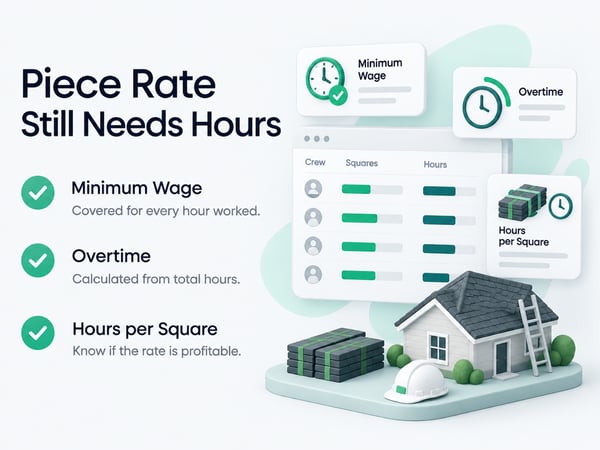
Paying by output does not remove the obligation to know hours. In many cases, hours are legally required.
Under federal wage law, for example, employees paid by piece rate generally must still receive at least minimum wage for all hours worked, and overtime generally applies to hours over 40 in a workweek. The regular rate for overtime is typically computed from total piece-rate earnings divided by total hours worked, with an additional premium for overtime hours. Some states add requirements, such as separate pay for non-productive time and rest breaks. Confirm the rules for your state with counsel.
That means you need accurate daily hours for every piece-rate employee. GPS time tracking creates that record: clock-in and clock-out with location, by job. Without it, you cannot prove minimum wage or calculate overtime correctly, and you cannot show hours in an audit or claim.
Time records also solve your own business problem. They let you compute hours per square for every job, which is the number that tells you whether your piece rate is profitable. See roofing production rates practices in the role guide, and apply the same idea: measure what each job really costs in labor.
Employee vs. Independent Contractor: A Major Risk
Many roofing companies pay crews by the square as "subcontractors." Paying by the square does not make someone an independent contractor.
Agencies and courts look at the actual relationship, including factors such as who controls the work, who supplies tools and materials, whether the worker can profit or lose based on their own management, how permanent the relationship is, and whether the work is integral to your business. The tests differ by agency and state. Misclassification can lead to back wages, taxes, penalties, and workers' compensation problems.
Basic protections:
- Get advice before treating a crew as independent
- Require proof of business registration, insurance, and workers' compensation coverage for true subcontractors
- Use written subcontracts with defined scope, price, and schedule
- Do not control how and when subs work in ways that look like employment
- Keep clear records either way
For true subcontractors, track their time on your jobs anyway if you need it for scheduling and cost comparison, and require the same photo documentation as your own crews. See how to fire a subcontractor for documentation standards when performance problems arise.
Building a Pay Plan That Protects Quality
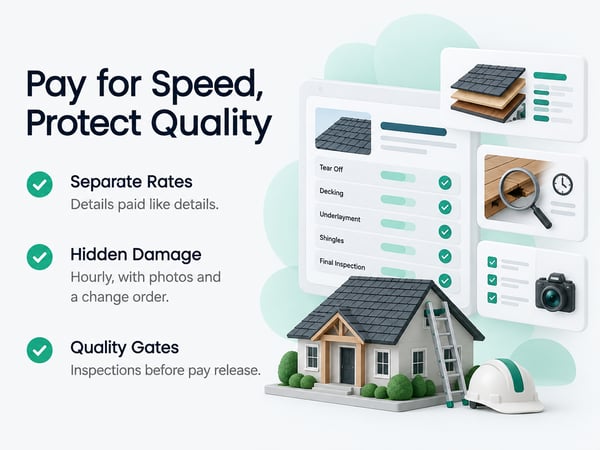
If you pay by the square, add quality gates and separate rates so speed does not win at the expense of the roof.
Practical features:
- Separate rates for different work: tear-off, decking repair, valleys, flashing, ridge, and cleanup each have their own rate or are paid hourly
- Rate adjustments for pitch and complexity, such as steep slopes or multiple stories
- Hourly pay for hidden-condition work, documented with photos and a change order
- Quality holdback: a portion of pay released after inspection passes. Confirm legal limits on holdbacks and deductions with counsel
- Callback accountability: callbacks fixed at crew expense only where your pay plan and local law allow
- Safety compliance as a condition, with fall protection checked daily
- Inspection checklists with photos at dry-in and completion. See the field inspection workflow
- Minimum guarantees so pay never falls below legal minimums for hours worked
Quality gates turn the pay plan into a quality system. The goal is a crew that earns well by doing the job correctly the first time.
Hourly and Hybrid: When They Fit
Hourly pay fits work where output is hard to measure or quality matters more than speed.
Use hourly for:
- Repairs and small jobs
- Complex or custom roofs
- Tear-off surprises and decking replacement
- Training new workers
- Warranty and callback work
- Storm tarping and emergency work
Hybrid models can work well. For example, an hourly base plus a bonus when a crew beats the labor-hour budget and passes inspection without callbacks. The bonus rewards both speed and quality. If you pay bonuses, check how they must be included in the regular rate for overtime calculations. Your payroll provider or attorney can confirm.
To set a fair bonus target, you need measured data: hours per square by roof type. See the next section.
Using Time Data to Set Rates That Work
Set piece rates from measured labor hours, not from what the neighbors pay.
Step 1: Measure hours per square by job type. Use GPS-verified time by cost code and squares completed. After 8 to 10 similar jobs, you have a reliable average and range.
Step 2: Calculate your labor cost per square.
Hours per square × loaded hourly labor cost = labor cost per square
Example (illustrative): 2.2 hours per square × $40 loaded cost = $88 per square.
Step 3: Decide the target. If a piece rate of $80 per square is paid in cash wages and your crew averages 2.2 hours per square, the effective wage is about $36 per hour. Compare that with the market wage for the skill level, and with minimum wage and overtime requirements.
Step 4: Test the effect of conditions. Steep, multi-story, and complex roofs may take 30 to 50 percent more time. Pay by the square on those without an adjustment and good crews will refuse them.
Step 5: Review quarterly. Material changes, new crews, and market shifts all move the numbers.
Use the same data for bids. See how to win construction bids, and for margin tracking see contractor profit and loss statement and construction WIP report.
Setting Up Time Tracking for Piece-Rate Crews
Keep the setup simple so workers actually use it.
- Create a project per address with a geofence
- Use cost codes by phase: tear-off, decking, underlayment, shingle install, flashing, cleanup, change orders, weather delay
- Add each worker and crew with their payroll IDs
- Require clock-in at the start of the day and clock-out at the end
- Record squares completed per phase in the job record, using the contract or supplier quantities
- Separate hourly work from piece-rate work using cost codes, so payroll applies the right pay
- Export hours and quantities to payroll with the piece-rate earnings
- Review weekly: total hours, squares, effective hourly rate, and overtime
Check effective hourly rate each week. If it falls below the minimum wage requirement for any worker, you need an adjustment, such as a guaranteed minimum.
For crew setup, see time tracking for construction workers and construction time tracking software. If your crews also work outdoors across scattered sites, the patterns in time tracking for landscapers will look familiar.
Contract and Documentation Language
Put the pay plan in writing and make sure it matches what you do.
Include:
- Pay rates by phase and condition
- How quantities are measured and who verifies them
- How hidden damage and extra work are paid
- How hours are recorded and reported
- Quality standards and inspection requirements
- Callback and warranty responsibilities
- Safety requirements and consequences
- How and when pay is issued
- Deductions and holdbacks, within legal limits
For customer contracts, make sure change order and unit price language covers the extra work your crews will do. See how to negotiate a construction contract for the clauses that matter.
Cash Flow and Seasonal Effects
Pay models affect cash timing. Piece-rate crews often expect pay at job completion or weekly, which can strain cash when customers pay later or insurance checks are slow.
- Match pay frequency to your receivables
- Track labor cost per job so you see margin before the final payment
- Plan for storm surges, when labor demand and cash needs spike together
See construction cash flow management for planning seasonal swings, and construction retainage for commercial work where payment is held back.
Decision Guide: Which Model Fits
Answer these to pick a starting point, then test it on a few jobs.
- [ ] Are most of your roofs simple and repeatable? Pay per square can fit.
- [ ] Do you have complex roofs, repairs, or storm work? Use hourly or hybrid for those.
- [ ] Do you have strong inspection and callback tracking? Piece rate with quality gates is safer.
- [ ] Are you short on supervision? Hourly with checklists gives more control.
- [ ] Are you training new workers? Hourly for the first months.
- [ ] Do you have accurate hours-per-square data? You can set piece rates with confidence.
- [ ] Do you need predictable labor cost on bids? Piece rate or a capped hybrid helps.
- [ ] Have you reviewed overtime and minimum wage rules with counsel? Do this before launch.
One-Page Piece-Rate Compliance and Quality Checklist
Pay plan
- [ ] Reviewed by an employment attorney or payroll specialist
- [ ] Separate rates or hourly pay for hidden damage, complex work, and cleanup
- [ ] Minimum wage guarantee for all hours worked
- [ ] Overtime calculation method confirmed
- [ ] Bonuses handled correctly in the regular rate
Records
- [ ] GPS-verified clock-in and clock-out for every worker
- [ ] Hours by cost code per job
- [ ] Squares completed per phase recorded
- [ ] Weekly effective hourly rate reviewed
- [ ] Edit log for any corrections
Quality
- [ ] Inspection checklist with photos at dry-in and completion
- [ ] Callbacks tracked by crew
- [ ] Safety checks daily
- [ ] Cleanup standards included in the pay plan
Classification
- [ ] Employee or independent contractor status reviewed with counsel
- [ ] Insurance and registration documents on file for true subs
- [ ] Written agreements in place
For platform comparisons on time tracking and payroll handling, see top 5 time tracking apps, top 5 BusyBusy alternatives, and TaskTag vs. BusyBusy.
Related Resources
Role Guide:
- Roofing Project Manager Role Guide: responsibilities and daily routines
TaskTag Features:
- GPS Time Tracking for Construction: verified hours for piece-rate and hourly crews
- Construction Time Tracking Software: platform overview and setup
- Time Tracking for Construction Workers: crew clock-in guide
- Top 5 Time Tracking Apps: platform comparison
- Top 5 BusyBusy Alternatives: alternatives guide
- TaskTag vs. BusyBusy: feature comparison
- Time Tracking for Landscapers: tracking for mobile outdoor crews
- Field Inspection Workflow: checklists and photos for quality gates
Related Blog Posts:
- Construction Defect Claims: the cost of rushed work
- How to Fire a Subcontractor: documenting sub performance
- How to Win Construction Bids: pricing from measured labor data
- Contractor Profit and Loss Statement: margin reporting
- Construction WIP Report: active job profitability
- How to Negotiate a Construction Contract: change order and unit price clauses
- Construction Cash Flow Management: seasonal planning
- Construction Retainage: payment holdbacks on commercial work