
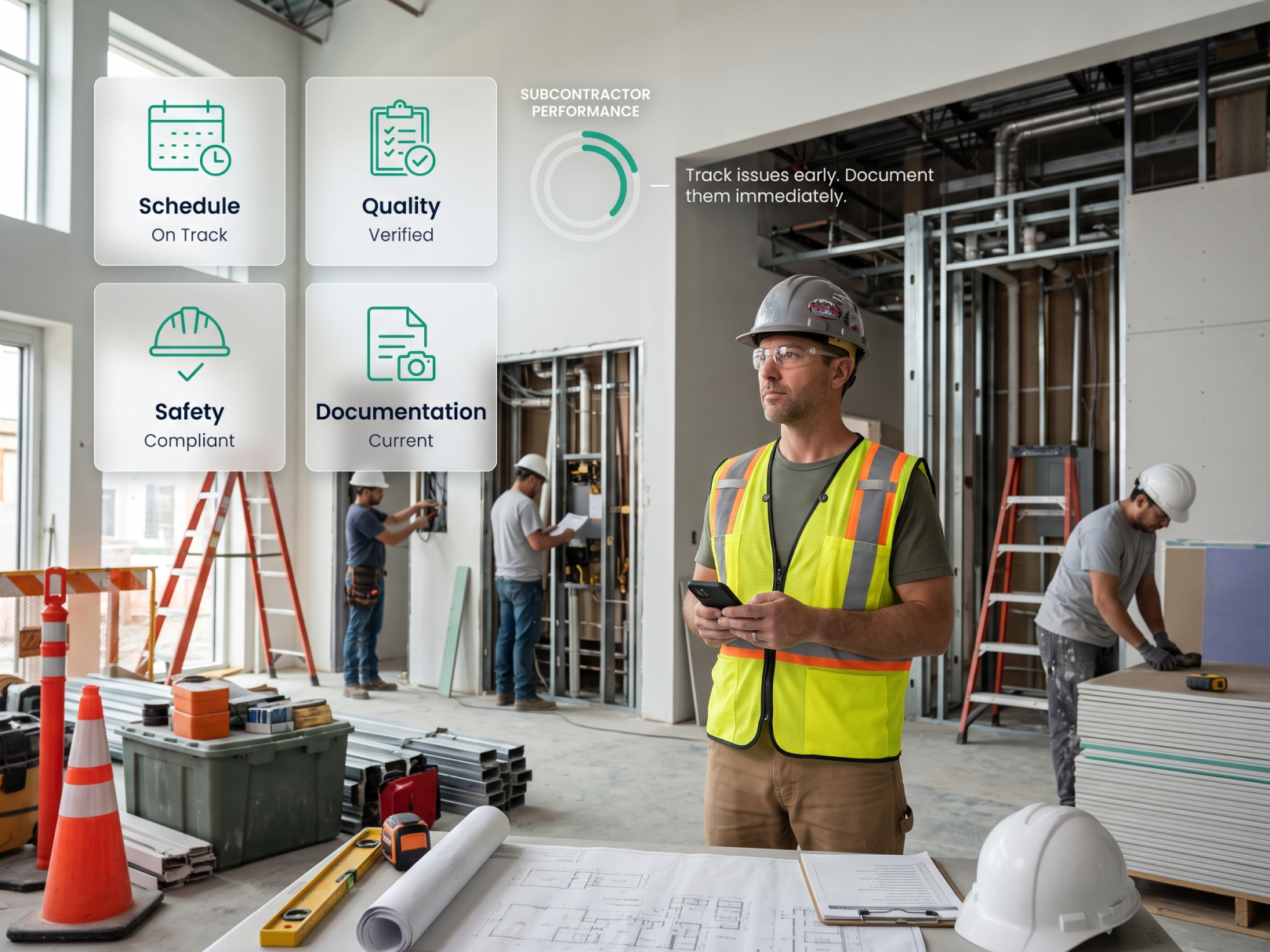
 On most commercial construction projects, subcontractors perform 60–80% of the work — yet most GCs spend more time managing their direct employees than the subs who represent the majority of project cost and schedule risk. A subcontractor who mobilizes late, performs defective work, fails a safety inspection, or goes bankrupt mid-project doesn't just affect their own scope. They stop adjacent trades, trigger delay claims, create lien exposure for the owner, and put the GC's reputation on the line with a client who doesn't care which tier failed.
Subcontractor management is the core operational discipline of general contracting. It starts before the contract is signed — in prequalification and scope leveling — runs through project execution with coordination, payment, and performance monitoring, and ends at closeout with final lien waivers, warranty documentation, and punch list completion. Every phase has specific practices that separate GCs who consistently deliver on time from those who spend their margins on subcontractor recovery.
Construction time tracking software enters subcontractor management in two ways: the GC's own construction time keeping app tracks labor on self-perform work alongside subcontract cost for job costing, and forward-thinking GCs require subs to use a contractor time tracking app for T&M work documentation, certified payroll compliance, and daily workforce reporting.
Phase 1: Subcontractor Prequalification
Prequalification is the vetting process that happens before a sub is allowed to bid or receive work. The goal: identify financial, safety, legal, and capacity problems before they become your problems on an active project.
When to prequalify:
- Any new sub not previously used
- Any sub not used in the last 2 years
- Any sub for a scope exceeding your company's threshold (often $50,000–$100,000)
- Annually for subs on the approved list — conditions change
Prequalification information to collect:
Financial Stability
A sub who can't make payroll in week 6 stops working in week 6. Financial distress is the most common cause of mid-project subcontractor failure.
Request:
- 2–3 years of financial statements (reviewed or audited preferred; compiled if that's all they have)
- Current bank reference letter confirming operating line of credit
- Bonding capacity letter from surety (for larger subs)
- Trade credit references — do suppliers extend them credit? On what terms?
Red flags:
- Declining revenue over 2+ years
- Negative working capital (current liabilities exceed current assets)
- No bonding capacity
- Suppliers who only supply COD (no credit extended)
Safety Record
A high-EMR sub is a high-risk sub. Their workers are injured at a higher rate — which means higher workers comp costs, higher incident probability on your project, and potential OSHA citations that reflect on the GC's site safety program.
Request:
- 3 years of OSHA 300 Logs
- Current EMR (Experience Modification Rate) from workers comp carrier — get the actual letter, not the contractor's self-reported number
- OSHA citation history — available on http://OSHA.gov by employer name
- Incident rate (TRIR — Total Recordable Incident Rate): TRIR = (Number of recordable incidents × 200,000) ÷ Total hours worked. Industry average for construction: ~3.0. Subcontractor with TRIR above 5.0 warrants scrutiny.
Thresholds common in prequalification:
- EMR above 1.2: requires explanation and remediation plan before approval
- EMR above 1.5: typically disqualified from prequalified list; may be acceptable only for small, low-risk scopes
- Active OSHA willful violations: disqualify pending resolution
Licensing and Insurance
License verification: Contractor license numbers are verifiable in state databases. Verify the license is current, the classification matches the scope being bid, and any required specialty licenses (electrician, plumber, elevator) are in place.
Insurance requirements: Minimum requirements for most commercial subcontracts:
- Commercial General Liability: $1M per occurrence / $2M aggregate
- Workers Compensation: statutory limits required by state law
- Auto Liability: $1M combined single limit (if sub uses vehicles on the project)
- Umbrella/Excess: $5M–$10M on larger projects
For higher-risk scopes:
- Professional Liability (design-assist subs, specialty engineering)
- Pollution Liability (hazmat, asbestos, roofing)
- Installation Floater (mechanical, electrical equipment)
Collect the Certificate of Insurance (COI) before mobilization. Verify the GC is named as Additional Insured on all policies — not just noted on the certificate. Get the endorsement, not just the declaration page.
Workforce Capacity
A sub who is already 90% booked can't staff your project adequately. Capacity questions:
- Current backlog (dollar value and months of work)
- Workforce size — how many journeymen available for this scope?
- Current project count and locations
- Key personnel assigned to your project (foreman, superintendent)
A sub who commits their B-team foreman because their A-team is on another job is a performance risk. Ask specifically who will run the field work on your project.
References
Three references from projects of similar size and scope completed in the last 3 years. Call them. Ask:
- Did they complete the scope on schedule?
- Was the quality of work acceptable without significant rework?
- Did they manage their own workers and lower-tier subs effectively?
- Did they submit accurate billing and required documentation on time?
- Would you use them again?
A sub who provides references but all of them are from 5+ years ago, or all from small projects when you're awarding a large one, is hiding something.
Phase 2: Scope Definition and Bid Leveling
Before awarding, confirm that every bidder is pricing the same scope. Scope gaps between bids create post-award disputes — the sub claims they didn't include X, the GC assumed they did.
Writing the Subcontract Scope of Work
The scope of work defines exactly what the sub is responsible for. Every ambiguity in the scope becomes a change order negotiation during the project.
Scope of work must include:
Inclusions (what IS in scope): Specific, detailed — not "all mechanical work" but a line-item list referencing drawing sheets and specifications sections:
- Furnish and install HVAC equipment per mechanical drawings M-001 through M-048
- All ductwork, insulation, diffusers, registers, and accessories
- Equipment startup and commissioning
- All penetrations and sleeves in GC-furnished structure
- Coordination with electrical and plumbing for utility connections
- Balancing reports, as-built drawings, O&M manuals
Exclusions (what is NOT in scope): Equally important — prevents scope creep claims:
- Electrical power to equipment (by electrical sub)
- BAS/controls (by controls sub under separate contract)
- Concrete equipment pads (by GC)
- Chemical treatment for hydronic systems (by owner's service vendor)
Schedule requirements:
- Mobilization date
- Milestone dates for specific phases (rough-in complete by X, startup by Y)
- Coordination requirements (submit shop drawings within 30 days, attend monthly sub coordination meetings)
Bid Leveling
Compare bids apples-to-apples — same scope, same exclusions, same allowances.
Bid leveling sheet:
Scope Item | Sub A | Sub B | Sub C | Included? ----------------------|------------|------------|------------|---------- Base scope | $285,000 | $267,500 | $310,000 | All Equipment startup | Included | $8,500 add | Included | Required As-built drawings | Included | Included | $2,500 add | Required Chemical treatment | Excluded | Excluded | Excluded | By owner Permits | Included | $3,200 add | Included | Required Sales tax | Included | Included | Excluded | Required ADJUSTED BID TOTAL: | $285,000 | $279,200 | $312,500 | Sub B is the apparent low bidder after leveling — not Sub A as the raw numbers suggested. Awarding without leveling would have left $6,200 in post-award change orders.
Scope gap conversations: Before awarding, call the low bidder and walk through every scope item line by line. "Do you include startup?" "Do you include balancing?" Verbal confirmation documented in an email immediately after the call — "As discussed today, your bid includes..." This email becomes the scope clarification reference if a dispute arises.
Phase 3: Subcontract Agreement
The subcontract agreement defines the legal relationship. Most disputes between GCs and subs are determined by the subcontract — what it says, what it's silent on, and how the dispute resolution clause works.
Critical subcontract clauses:
Scope of Work
By reference to the bid scope document, the drawings and specifications sections that apply, and any scope clarification correspondence.
Contract Price and Payment Terms
- Lump sum amount or T&M basis
- Schedule of values (if required for progress billing)
- Payment cycle: sub submits invoice by X date, GC pays within Y days of receiving owner payment ("pay when paid") or within Z days regardless ("pay if paid")
Pay-when-paid vs. pay-if-paid: "Pay when paid" makes payment timing contingent on the GC receiving owner payment — not payment itself. "Pay if paid" shifts the risk of owner non-payment to the sub. Some states limit or prohibit pay-if-paid clauses for subs. Know your state's law and draft accordingly.
Retainage
Percentage held, conditions for reduction, and release. Sub retainage typically mirrors GC retainage from the owner — if the owner holds 10%, the GC holds 10% from the sub. See Construction Retainage for retainage management detail.
Schedule Requirements
Mobilization date, milestone dates, requirement to participate in GC's scheduling process, consequences for schedule failure.
Changes
How changes are authorized — written change order required before proceeding, emergency verbal authorization procedure, T&M documentation requirements for change order work. A sub who proceeds without written authorization has a weaker claim for payment.
Insurance Requirements
Specific limits, endorsements required (Additional Insured, Waiver of Subrogation), notification requirements for policy changes or cancellations.
Safety
Sub responsibility for their own workers' safety, compliance with GC safety plan, right of GC to stop work for safety violations, right of GC to remove workers who create unsafe conditions.
Indemnification
Standard construction indemnification: sub indemnifies GC for claims arising from sub's work, subject to applicable state limitations.
Dispute Resolution
Mediation first, then arbitration or litigation — matching the GC's dispute resolution clause with the owner. The sub's dispute resolution must be compatible with the prime contract — you can't bring an owner dispute to arbitration if the sub contract requires litigation.
Flow-Down Clauses
All prime contract requirements applicable to the sub's scope flow down automatically. The sub is bound by everything the GC is bound by, to the extent it relates to the sub's scope. This is particularly important on Davis-Bacon prevailing wage projects — the sub's workers must be paid prevailing wages and certified payroll must be submitted.
Phase 4: Pre-Construction Coordination
Pre-construction meeting with each major sub before mobilization:
- Walk the scope: confirm the sub's foreman understands exactly what's included and excluded
- Review the schedule: confirm mobilization date and milestone understanding
- Establish communication channels: who calls whom for what
- Review site rules: parking, access, safety requirements, toolbox talk participation
- Confirm submittal requirements and deadlines: shop drawings, product data, samples — what's needed and by when
- Confirm billing procedure: how the sub submits invoices, required supporting documentation, billing cycle dates
Document the pre-construction meeting in writing — distribute meeting minutes within 48 hours. Anything agreed in the meeting that isn't in the subcontract gets documented here.
Contractor time tracking software discussion: For subs performing T&M work or working on prevailing wage projects, the pre-construction meeting is the right time to establish time tracking requirements. A sub who uses construction employee time tracking that produces GPS-verified daily reports makes T&M billing documentation and certified payroll compliance simpler — and gives the GC visibility into the sub's workforce on site.
Phase 5: Performance Monitoring During Construction
Schedule Performance
Track sub progress against the project schedule weekly. Three questions:
- Is the sub's crew size adequate for the scheduled work pace?
- Is the scope progressing at the rate needed to hit the next milestone?
- Are there any external constraints the sub needs resolved (access, GC work ahead of them, material deliveries)?
Early warning signals:
- Sub crew showing up smaller than planned — check daily workforce count via site sign-in or GPS records from construction time clock app
- Material deliveries delayed — sub hasn't ordered in time
- Sub waiting on GC predecessor work — GC schedule is the problem, not sub performance
When schedule slippage is the sub's fault: document immediately in writing. "As discussed on [date], [Sub Company] is currently [X days] behind the approved schedule for [scope]. Please provide a recovery plan by [date]." A documented schedule warning is essential if the relationship later escalates to termination or delay claims.
Quality Performance
Inspect sub work before it's covered. A drywall inspection after paint is applied is an argument about what's behind it. A pre-drywall MEP inspection while the rough-in is visible costs 30 minutes and prevents weeks of rework.
Document quality issues in writing: Email the sub foreman and their company's superintendent immediately when a quality defect is identified. Include photographs. State the required corrective action and deadline. A documented quality record is essential if retainage release or final payment becomes disputed.
Safety Performance
The GC's safety obligation extends to sub workers on the project. Sub safety failures create OSHA liability for the GC.
Sub safety violations: documented immediately, corrective action required before the work resumes. Repeat violations: escalate to the sub's company management. Workers who create unsafe conditions: GC has the right under most subcontracts to remove them from the project.
Payment and Billing Management
Sub invoice review:
- Verify percent complete claimed matches work actually performed (walk the job before approving)
- Confirm all required documentation is attached: conditional lien waivers for this period, unconditional waivers from prior period
- Verify certified payroll is included (prevailing wage projects)
- Hold retainage per subcontract terms
Lien waiver collection: Make lien waiver collection part of the payment process — sub doesn't get paid for period N until the conditional waiver for period N and the unconditional waiver for period N-1 are received. Build this into the payment processing workflow, not as an afterthought when the billing application to the owner is due.
See Construction WIP Report for how subcontract percent complete feeds the GC's WIP position and billing accuracy.
Phase 6: Managing Underperforming Subcontractors
.jpg?width=600&height=450&name=3%20(83).jpg)
A sub who is behind schedule, producing defective work, or failing safety requirements requires a structured response — not silence, not threats, not informal conversations that don't create a record.
Step 1: Written notice of default Document the specific failure (schedule, quality, safety), the specific subcontract provision violated, and the required corrective action with a specific deadline. Send by email and certified mail.
Step 2: Recovery plan submission Require the sub to submit a written recovery plan — how they will correct the deficiency, what resources they will add, what the revised schedule looks like. A recovery plan that isn't executable ("we'll try harder") is not a recovery plan.
Step 3: Recovery plan monitoring Weekly check against the recovery plan commitments. If the sub isn't meeting their own commitments, document each failure.
Step 4: Termination If the sub fails to cure the default within the notice period and the recovery plan isn't working, the subcontract termination clause applies. See How to Fire a Subcontractor for the complete termination process, financial exposure management, and replacement sub mobilization.
The documentation trail from Steps 1–3 is essential for Step 4. A GC who terminates a sub without documented prior warnings faces a breach of contract claim. A GC who has three written notices of default, a recovery plan, and documented recovery plan failures has a defensible record.
Closeout: Subcontractor Completion Requirements
Before releasing final payment and retainage, confirm every closeout requirement is satisfied:
- [ ] Punch list complete — GC confirms all punch list items related to the sub's scope are resolved
- [ ] Final lien waiver (unconditional) received
- [ ] All sub-tier lien waivers received — sub's suppliers and lower-tier subs
- [ ] Warranty documentation submitted — written warranty per subcontract terms, typically 1 year minimum
- [ ] O&M manuals submitted (mechanical, electrical, specialty equipment)
- [ ] As-built drawings submitted
- [ ] Test and balance reports (HVAC), startup reports (equipment), inspection certifications
- [ ] All permits closed — sub is responsible for closing any permits they pulled
- [ ] Certified payroll submitted for all periods (prevailing wage projects)
Final payment and retainage release is the GC's last leverage point. Don't release it until the list is complete. See Construction Project Closeout for the full GC closeout process.
Common Subcontractor Management Mistakes
.jpg?width=600&height=450&name=3%20(84).jpg)
Skipping prequalification on repeat subs A sub who performed well 3 years ago may have changed management, lost key personnel, taken on too much work, or deteriorated financially. Annual re-prequalification catches these changes before they arrive on your project.
Awarding to the lowest bid without scope leveling The apparent low bid is often not the true low bid. Scope gaps discovered after award become change orders — at the sub's markup, on their schedule, with no competitive pressure.
Ambiguous scope of work Scope defined by reference to "all work shown on the drawings" without specific inclusions and exclusions produces disputes on every ambiguous detail. Specific scope documents eliminate most post-award disputes before they start.
Not collecting updated COIs Insurance policies expire annually. A sub whose policy lapses mid-project is uninsured while on your site — and the GC's insurance becomes the backstop. Calendar COI expiration dates and require renewal certificates before expiration.
Paying without lien waivers Every dollar paid to a sub without a conditional lien waiver is a dollar that creates lien exposure without the corresponding protection. Lien waiver collection is non-negotiable — never pay without it.
Verbal-only performance conversations A sub who is warned verbally and then terminated can claim they didn't know there was a problem. Every performance conversation gets documented in writing within 24 hours.
Subcontractor Management Checklist
Pre-award:
- [ ] Prequalification complete — financial, safety, license, insurance, references
- [ ] Scope of work written with specific inclusions, exclusions, and schedule requirements
- [ ] Bids leveled — all bids cover the same scope
- [ ] Scope clarification confirmed in writing before award
- [ ] Subcontract executed — all required clauses, flow-down provisions
- [ ] COI received and verified — Additional Insured endorsement confirmed
Pre-construction:
- [ ] Pre-construction meeting held — scope, schedule, site rules, billing procedure
- [ ] Meeting minutes distributed
- [ ] Submittal schedule agreed — shop drawing deadlines confirmed
- [ ] Time tracking / certified payroll requirements communicated
During construction:
- [ ] Weekly crew count and progress review
- [ ] Schedule variance documented in writing if behind
- [ ] Quality inspections before work is covered
- [ ] Quality defects documented in writing with photographs
- [ ] Monthly invoice review — percent complete confirmed, documentation complete
- [ ] Lien waivers collected every pay period
- [ ] COI monitored for expiration
Closeout:
- [ ] Punch list complete for sub's scope
- [ ] Final unconditional lien waiver received
- [ ] All sub-tier waivers received
- [ ] Warranty documentation submitted
- [ ] Closeout submittals complete
- [ ] Final payment and retainage released
Related Resources
TaskTag Features
- GPS Time Tracking for Construction — GPS-verified workforce records for sub daily reporting and T&M documentation
- Construction Time Tracking Software — requiring subs to use time tracking for certified payroll and T&M billing
- Time Tracking for Construction Workers — sub worker-level time records for GC job cost visibility
- Top 5 Construction Time Tracking Apps — apps subs can use for certified payroll compliance
- Top 5 BusyBusy Alternatives — time tracking alternatives for subcontractor workforce management
- TaskTag vs. BusyBusy — sub management and certified payroll feature comparison
Related Blog Posts
- How to Fire a Subcontractor — termination process when performance management fails
- Construction Retainage — retainage management through the sub payment lifecycle
- Construction Bonds Guide — payment bond claims on bonded projects when sub fails
- How to Negotiate a Construction Contract — sub flow-down clauses and payment terms in contract negotiation
- Construction Project Closeout — sub closeout requirements and final payment process
- Construction WIP Report — subcontract percent complete in GC WIP billing position
- Construction Cash Flow Management — sub payment timing and cash flow management