

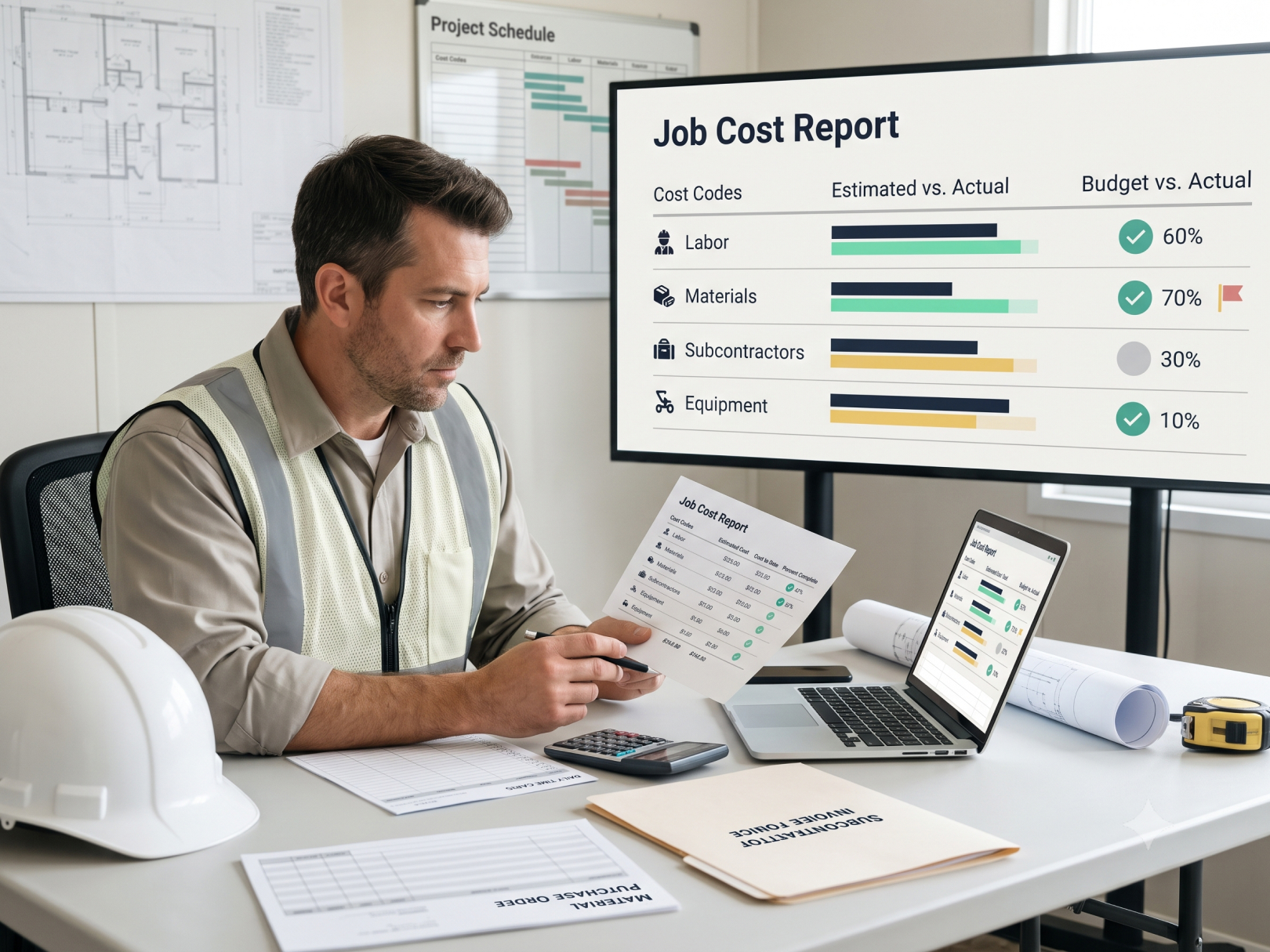
Contractors who track job costs in real time protect their margins. The difference is not better estimating — it’s catching problems while there’s still time to recover.
A labor overrun discovered in week three of a twelve‑week project is manageable. The same overrun discovered at final billing becomes absorbed profit loss.
Construction job costing is not bookkeeping.
Bookkeeping tracks what you spent. Job costing tracks what you spent against what you planned to spend — by project, by cost category, in real time.
Contractors who combine disciplined cost tracking with structured construction project management software gain visibility into labor, materials, and subcontractor performance as work happens.
If you want a broader foundation before diving into cost control, review this construction project management guide.
What Construction Job Costing Actually Tells You
Job costing answers four questions your P&L cannot:
- Which jobs made money and which didn't? Your P&L shows total company profit. Job costing shows profit by project — so you know whether your commercial work is subsidizing your residential work, or which project types consistently underperform your estimate.
- Where specifically did the money go? Not just "labor was over budget" but "labor on concrete flatwork was 140% of estimate because we had to redo the pour." That specificity improves your next estimate.
- Is this project still going to hit its margin? Real-time cost tracking lets you forecast cost-to-complete and catch margin erosion before the work is done.
- What's happening right now? Your Contractor P&L Statement is a lagging indicator — it shows last month. Job costing is current. It reflects work posted this week.
Detailed job cost breakdown improves future estimating accuracy. If your team needs better field visibility to reduce rework, structured jobsite photos and daily progress tracking can tighten oversight.
Contractors looking to modernize cost visibility often evaluate this best CompanyCam alternative for contractors to improve documentation and reporting.
Setting Up Your Cost Code Structure
Cost codes are the foundation of job costing. Every dollar spent gets assigned a cost code that identifies both the cost type (labor, material, sub, equipment) and the scope of work. Without cost codes, all you know is total spend. With cost codes, you know exactly where the money went.
The four cost types — use these on every code:
|
Type |
Code |
What It Includes |
|
Labor |
L |
Direct field labor — wages, payroll taxes, workers comp |
|
Material |
M |
Materials purchased for the specific job |
|
Subcontractor |
S |
Payments to subs for specific scope |
|
Equipment |
E |
Owned equipment (time charges) or rented equipment |
Scope codes — adapt to your trade:
General contractors typically use CSI MasterFormat divisions as their base:
|
Division |
Scope |
|
01 |
General conditions (supervision, temp facilities, permits) |
|
02 |
Sitework and demolition |
|
03 |
Concrete |
|
04 |
Masonry |
|
05 |
Structural steel |
|
06 |
Rough carpentry / framing |
|
07 |
Thermal and moisture protection (insulation, roofing, waterproofing) |
|
08 |
Doors, windows, glazing |
|
09 |
Finishes (drywall, flooring, painting, tile) |
|
10 |
Specialties |
|
15 |
Mechanical (plumbing, HVAC) |
|
16 |
Electrical |
Combined cost code format: Division + Type = one cost code.
- 03-L = Concrete labor
- 03-M = Concrete materials
- 03-S = Concrete subcontractor
- 06-L = Framing labor
- 09-M = Finish materials
Smaller contractors can simplify to 6–8 scope codes. Complexity should match your project scale — a $200K remodeler doesn't need 50 cost codes.
Phase codes for larger projects: Break scope codes into project phases (foundation, framing, rough-in, finishes) for more granular tracking. Only add this layer if your projects run 6+ months and you estimate by phase.
Smaller contractors should simplify. Complexity must match project size.
For contractors seeking workflows built specifically around cost codes and field reporting, explore this construction management app for general contractors.
Direct vs. Indirect Costs
Correct classification protects both margins and financial reporting.
Direct Costs
- Field labor
- Materials
- Subcontractor payments
- Job-specific permits
- Equipment rentals
Indirect Costs (Overhead)
- Office rent
- Administrative salaries
- Accounting
- Marketing
- General liability insurance
If overhead is not allocated correctly, jobs appear more profitable than they actually are.
For deeper breakdowns on overhead allocation and markup, explore additional construction software guides and tips.
Tracking Labor Costs
Labor overruns destroy margins faster than any other category.
Every field employee should complete daily time cards — not weekly summaries.
Minimum fields:
- Employee name
- Project
- Cost code
- Hours worked
- Overtime indicator
If workers are on multiple jobs in one day: Split the hours by job and cost code. "4 hours framing at [Job A], 3 hours demo at [Job B]."
Labor cost per hour includes more than wages. Full burden rate includes:
|
Component |
Approximate % of Base Wage |
|
Base wage |
100% |
|
Payroll taxes (FICA, FUTA, SUTA) |
10–12% |
|
Workers compensation |
5–30% (varies by trade and EMR) |
|
General liability (labor allocation) |
2–5% |
|
Benefits (health, vacation, tools) |
5–15% |
|
Total burden |
125–160% of base wage |
If a carpenter earns $30/hour, their true cost to you is $37.50–$48/hour. Your estimate must be built on burdened labor rates, not wage rates — otherwise every labor-heavy job will show a budget overrun. See How to Estimate Construction Costs for burdened rate calculation.
Contractors who implement GPS timesheets for contractors reduce labor misallocation and improve accuracy.
Roofing companies in particular benefit from structured roofing photo documentation and crew tracking systems when managing distributed crews.
Tracking Material Costs
Purchase Orders
Every material purchase should have a purchase order (PO) assigned to a specific job and cost code before the order is placed. This links the cost to the job in your system when the invoice arrives — no manual sorting later.
PO fields:
- PO number (sequential)
- Project name and number
- Cost code
- Vendor
- Description of materials
- Estimated quantity and unit price
- Date ordered / expected delivery
For smaller purchases without formal POs, require employees to note the job name on every receipt at the time of purchase.
Handling Material Variances
Over-ordering: Unused materials returned to supplier create a credit that must be applied back to the job cost. A common job cost error: the purchase gets coded to the job, the credit goes to a general account, and the job looks more expensive than it was.
Material theft and waste: Track material waste against your estimate's waste factor. Excessive waste signals a field efficiency problem. Unexplained shortfalls may indicate theft.
Price escalation: When material costs increase after you've signed a contract, document the variance immediately. This is the basis for a change order request if your contract allows material escalation claims. See Construction Change Order Template for escalation documentation language.
Structured photo documentation for contractors strengthens change order support with timestamped delivery and installation records.
Tracking Subcontractor Costs
Subcontractor job costs are straightforward in theory — you have a signed subcontract with a dollar amount. In practice, three things create sub cost tracking problems:
Change orders not yet approved. A sub performs extra work, submits a change order request, and you're waiting for owner approval. The cost is real and should be reflected in your job cost as a pending item — otherwise your cost-to-complete forecast is understated.Back-charges. When you charge a sub for something (cleanup, rework, coordination labor), it reduces their subcontract cost. Back-charges must be tracked in the job cost system — if you forget to credit them, the sub line looks over budget when it isn't.
Sub payment terms vs. actual completion. You may be withholding retainage from a sub, but their portion of the work is complete and the cost is incurred. Your job cost should reflect the full earned value of their work, not just what you've paid them.
For sub management, vetting, and default documentation, see Construction Subcontractor Prequalification, How to Manage Subcontractors, and How to Fire a Subcontractor.
For real-world examples of improved subcontractor coordination and communication, review this construction project management case study.
You can also read how vendors improved coordination in this construction delivery tracking case study.
Tracking Equipment Costs
Rented equipment: Direct cost to the job — code the rental invoice to the appropriate job and cost code when it arrives.
Owned equipment: Requires internal time charges. Without charging owned equipment to jobs, you understate job costs and can't compare owned-equipment jobs to rented-equipment jobs accurately.
Set an internal hourly or daily rate for each piece of owned equipment based on:
- Depreciation (annual depreciation ÷ annual hours of use)
- Maintenance and repair (annual average ÷ annual hours)
- Insurance
- Fuel (average per hour of operation)
A $120,000 excavator with 1,200 annual operating hours, $15,000/year in maintenance and fuel, and $24,000/year in depreciation has an internal rate of roughly $32.50/hour. Each hour on a job gets charged $32.50 to that job's equipment cost code.
This feeds your equipment utilization tracking — if the excavator is only generating 800 hours of internal charges per year against 1,200 hours available, you have an underutilization problem.
Overhead Allocation
- Total annual overhead costs (from your Contractor P&L)
- Divide by total annual direct labor hours (or revenue — choose one method and stick to it)
- Result = overhead rate per labor hour (or overhead percentage of revenue)
Example using labor hours:
- Annual overhead: $480,000
- Annual direct labor hours: 12,000
- Overhead rate: $40/labor hour
Every hour of direct labor on a job gets $40 of overhead allocated to it. A job with 500 direct labor hours absorbs $20,000 of overhead.
Example using revenue percentage:
- Annual overhead: $480,000
- Annual revenue: $3,200,000
- Overhead rate: 15% of revenue
A $400,000 job absorbs $60,000 of overhead.
For detailed overhead rate calculation and markup methodology, see Construction Overhead and Profit and General Contractor Markup.
The Weekly Job Cost Report
.jpg?width=600&height=450&name=2%20(32).jpg)
Run a job cost report weekly.
Review:
- Cost to date
- Remaining budget
- Estimated cost at completion
- Over/under variance
Any code trending beyond 110% of budget requires investigation.
If margin erosion appears, address immediately.
Contractors who centralize documentation, cost tracking, and reporting into one system often see fewer surprises. Review TaskTag product features to understand integrated job tracking capabilities.
Job Cost Report Template:
Project: [Name] | Contract Value: $_______ | Estimated Margin: ___% | Period: Week ending _______
|
Cost Code |
Description |
Estimated Cost |
Cost to Date |
Remaining Budget |
% Complete |
Est. Cost at Completion |
Over/Under |
|
01-L |
Supervision labor |
$24,000 |
$11,200 |
$12,800 |
45% |
$24,900 |
($900) |
|
01-M |
General conditions materials |
$8,500 |
$3,100 |
$5,400 |
36% |
$8,600 |
($100) |
|
03-S |
Concrete subcontractor |
$42,000 |
$42,000 |
$0 |
100% |
$42,000 |
$0 |
|
06-L |
Framing labor |
$38,000 |
$22,400 |
$15,600 |
68% |
$43,200 |
($5,200) |
|
06-M |
Framing materials |
$31,500 |
$19,800 |
$11,700 |
65% |
$30,500 |
$1,000 |
|
09-S |
Drywall subcontractor |
$28,000 |
$0 |
$28,000 |
0% |
$28,000 |
$0 |
|
15-S |
Mechanical subcontractor |
$55,000 |
$27,500 |
$27,500 |
50% |
$55,000 |
$0 |
|
16-S |
Electrical subcontractor |
$48,000 |
$24,000 |
$24,000 |
50% |
$48,000 |
$0 |
|
Total |
$275,000 |
$150,000 |
$125,000 |
54% |
$280,200 |
($5,200) |
Reading the report:
- Framing labor is tracking $5,200 over budget — needs immediate investigation
- Concrete is complete and on budget
- All subs are tracking on budget so far
- Total project trending $5,200 over estimate — margin erosion of ~1.9%
The "Est. Cost at Completion" column is the critical one. It's your forecast of total project cost based on current performance. Calculate it:
- For completed scopes: actual cost
- For in-progress scopes: actual cost to date ÷ percent complete
- For not-started scopes: original estimate (unless you have reason to revise)
This feeds directly into your Construction WIP Report, which uses estimated cost at completion to calculate over/under billing and project profit.
10 Common Construction Job Cost Mistakes
.jpg?width=600&height=450&name=2%20(33).jpg)
Coding overhead to job costs. Your truck payment, office rent, and your own salary are overhead — not direct job costs. Putting them in job costs overstates project costs and understates your overhead rate. Next year's estimate will be wrong.
Not coding owner's time. If you personally supervise projects, your time has a cost. An owner spending 10 hours/week on a project at $100/hour of economic value is a $1,000/week job cost that's invisible if not tracked.
Mixing retainage with costs. Retainage withheld from subs is not a cost reduction — it's a liability (you owe it when the work is complete). Don't net retainage against subcontractor costs in your job cost system.
Posting costs to the wrong job. A common error when multiple jobs are running simultaneously. Especially common with material deliveries — a truck delivers to Job A but the invoice gets coded to Job B. Requires weekly reconciliation.
Ignoring pending change orders. Costs for change order work are incurred whether or not the owner has approved the CO. Show them as pending in job costs. Ignoring them understates your cost-to-complete and overstates margin.
Late cost entry. Costs posted 30–60 days after incurred make weekly job cost review meaningless. Require field supervisors to submit time cards daily and code material invoices within 3 days of receipt.
Not tracking rework. Rework costs — tearing out and redoing work — should be a separate cost code (or at least flagged). If rework is buried in labor costs, you can't see its true impact and you can't improve.
Using estimated costs as actuals. Some contractors enter estimated costs when invoices haven't arrived yet, then forget to replace with actuals. Estimated costs should be clearly marked and replaced when real invoices arrive.
Forgetting small tools and consumables. Blades, bits, fasteners, caulk, tape, sandpaper — individually small, collectively significant. Budget a consumables line per project and track it.
Closing the job before all costs are in. Final subcontractor invoices, warranty callbacks, punch list labor — these arrive after substantial completion. Don't close a job cost report until 60–90 days after project closeout. See Construction Project Closeout for final cost reconciliation timing.
Many of these issues stem from lack of structured field‑to‑office reporting.
Contractors looking to improve accountability can download the TaskTag app to manage projects directly from the field.
Job Costing and Financial Reports
Job costing connects to three other critical financial tools:
Estimating: Your estimate is your job cost budget. Variances between estimate and actual costs become inputs to next year's estimate — if framing labor consistently runs 115% of estimate, your labor productivity assumption is wrong. See How to Estimate Construction Costs.
WIP Report: Estimated cost at completion from your job cost report is the primary input to your WIP schedule. Inaccurate job costs = inaccurate WIP = over/underbilling you can't see = financial statements that mislead your bonding company and bank. See Construction WIP Report.
P&L Statement: Monthly job cost summaries roll up to your P&L. A company-level P&L without job-level cost detail can't tell you where the margin actually came from or went. See Contractor Profit and Loss Statement.
Job cost data also affects your tax filing — job costs incurred but not yet billed affect revenue recognition timing. See Contractor Tax Deductions for how job costs flow to your tax return.
For ongoing education, explore the contractor productivity blog for practical construction management insights.
Final Thoughts: Protecting Profit with Real-Time Job Costing
Construction job costing is not optional.
It is the difference between knowing and guessing.
Contractors who:
- Track labor daily
- Code materials correctly
- Monitor subs weekly
- Allocate overhead accurately
- Forecast cost‑to‑complete
Protect margin consistently.
If you want to implement structured job costing and field reporting:
- Review TaskTag pricing plans to compare options
- Or start your free TaskTag account to test job cost tracking workflows
- You can also schedule a construction software demo for a live walkthrough
To learn more about the company built specifically for contractors, visit About TaskTag.
Job Cost Checklist
Project setup:
- [ ] Project number assigned
- [ ] Cost codes set up matching estimate structure
- [ ] Estimate entered as budget in job cost system
- [ ] Purchase orders linked to project and cost codes
- [ ] All subs' contract amounts entered
Weekly during project:
- [ ] All labor time cards entered and coded
- [ ] All material invoices coded to correct job and cost code
- [ ] All sub invoices entered against subcontract amounts
- [ ] Job cost report pulled and reviewed
- [ ] Variances over 10% investigated and documented
- [ ] Est. Cost at Completion updated
- [ ] WIP schedule updated
At project closeout:
- [ ] All final sub invoices entered
- [ ] All punch list and warranty labor coded
- [ ] Final job cost report printed and filed
- [ ] Actual vs. estimate variance summary prepared
- [ ] Key variances documented for estimating improvement
- [ ] Job closed in system 60–90 days post-completion
Related Resources
- Construction WIP Report — how job cost data feeds your WIP schedule and balance sheet
- Contractor Profit and Loss Statement — company-level P&L and how job costs roll up
- Construction Overhead and Profit — overhead rate calculation and allocation methodology
- General Contractor Markup — markup vs. margin, pricing for your target profit
- How to Estimate Construction Costs — building the estimate that becomes your job cost budget
- Construction Cash Flow Management — managing cash when job costs reveal overruns
- Construction Budget Template — project budget structure aligned to cost codes
- Contractor Tax Deductions — how job costs and overhead flow to your tax return
- Construction Change Order Template — documenting scope changes that affect job cost
- How to Negotiate a Construction Contract — contract terms that protect your ability to track and recover costs
- Construction Subcontractor Prequalification — vetting subs before their costs become your problem
- How to Fire a Subcontractor — cost documentation when a sub defaults
- Construction Project Closeout — final cost reconciliation and job close process
- Construction Bonds Guide — how bonding companies use WIP and job cost data
- How to Grow a Construction Business — scaling systems including job costing infrastructure
.jpg?height=200&name=3%20(14).jpg)