

Contractors lose an estimated $40 billion annually to unpaid change orders — work that was...

Scope creep is the #1 profit killer in residential construction. The average residential project experiences 3–5 change orders, and contractors who don't document them properly lose an estimated $12,000–$18,000 per project in unrecovered labor and materials (Buildertrend, 2024).
Key Takeaways
- Residential projects average 3–5 change orders — contractors without a system lose $12,000–$18,000 per project (Buildertrend, 2024)
- A change order must be signed before work begins — verbal approvals are unenforceable in most disputes
- Every change order needs 5 fields: description, price adjustment, schedule impact, reason, and both signatures
- Change orders submitted before work begins are approved at 4x the rate of those submitted after completion
What Is a Construction Change Order and When Do You Use One?
A construction change order (CO) is a written amendment to the original contract documenting any change to scope, price, or schedule. It is not a request — it is a binding amendment. Both parties sign before additional work begins.
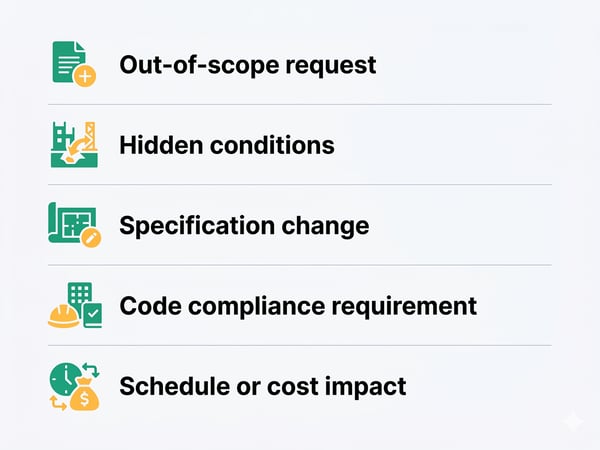
Use a change order any time:
- The client asks for work not in the original scope ("while you're at it...")
- Hidden conditions are discovered (rot, mold, incorrect prior work)
- The client changes a specification after work has started
- Code compliance requires work beyond the original scope
- Delays affect schedule or cost
Our finding: The contractors who get paid for every change order aren't the ones who argue best — they're the ones who make signing the easiest step. A one-page form on a phone that a client signs with a finger in 60 seconds gets signed. A PDF requiring printing and scanning gets avoided. Reduce friction to zero.
Your original contract is what makes change orders enforceable. See our construction contract template — specifically Clause 5, which establishes that no out-of-scope work proceeds without a signed change order.
Construction Change Order Template: All 7 Fields
Field 1: Project and Document Header
CONSTRUCTION CHANGE ORDER
Change Order #: CO-[###] Date: ___________
Project Name: _______________________________
Project Address: _____________________________
Original Contract Date: ______________________
Original Contract Amount: $__________________
Contractor: _________________________________
Owner/Client: _______________________________
Sequential CO numbers (CO-001, CO-002) create a clear amendment history and prevent "I never agreed to that" disputes.
Field 2: Description of Changed Work
DESCRIPTION OF CHANGED WORK
Work to be added / removed / modified:
_____________________________________________
_____________________________________________
Location on project: _________________________
Reason for change:
☐ Client request
☐ Hidden/unforeseen conditions
☐ Client specification change
☐ Code compliance requirement
☐ Design revision
☐ Other: ____________________________________
Materials affected: __________________________
Subcontractors affected: _____________________
Describe the work as if writing it for a judge. Write it so a third party with no project knowledge could understand exactly what changed and why.
Field 3: Price Adjustment
PRICE ADJUSTMENT
Labor:
Trade: ___________ Hours: ___ Rate: $___/hr Total: $______
Trade: ___________ Hours: ___ Rate: $___/hr Total: $______
Materials:
Item: ____________ Qty: ___ Unit: $___ Total: $______
Item: ____________ Qty: ___ Unit: $___ Total: $______
Subcontractor costs: $______
Equipment / rental: $______
Overhead & profit (____%): $______
────────────────────────────────
Change Order Subtotal: $______
☐ Addition ☐ Deduction ☐ No cost change
Original contract: $______
Previous COs total: $______
This CO: + $______
─────────────────────────────────────
REVISED CONTRACT TOTAL: $______
Always show the running contract total. Surprises at final invoice create disputes — a cumulative figure eliminates them. See our contractor invoice template for how to invoice change order amounts tied to your milestone payment schedule.
Field 4: Schedule Impact
SCHEDULE IMPACT
☐ No change to project schedule
☐ Project extended by ___ calendar days
New estimated completion: _______________
☐ Project moved earlier by ___ calendar days
Reason: _____________________________________
Document schedule impacts even with no price change. A client who complains about a 2-week delay needs to see a signed change order that authorized it.
Field 5: Payment Terms
PAYMENT TERMS
This Change Order amount is due:
☐ With the next scheduled milestone payment
☐ Upon completion of this CO work
☐ Per revised schedule: _____________________
If this CO exceeds $_____, a deposit of $_____ (___%)
is required before work begins.
Field 6: Signatures
AUTHORIZATION
By signing, both parties agree:
- Work described is outside original scope
- Price and schedule adjustments are agreed
- Contractor is authorized to proceed
- This CO becomes part of the original Contract
Work does not begin until both parties sign.
Contractor: _____________________ Date: _______
Owner: __________________________ Date: _______
☐ Signed in person ☐ Signed electronically
Get the signature before work begins — not after. A change order signed after work is complete is an invoice dispute, not a change order.
Field 7: Running Contract Log
CONTRACT AMENDMENT LOG
Original Contract: $__________
CO #001 ([date] — [brief desc]): $__________
CO #002 ([date] — [brief desc]): $__________
CO #003 (this document): $__________
────────────────────────────────────────────────────
REVISED CONTRACT TOTAL: $__________
Copy-Ready Template
═════════════════════════════════════════════
CONSTRUCTION CHANGE ORDER
═════════════════════════════════════════════
CO #: _______ Date: ___________________
Project: __________________________________________
Address: __________________________________________
Original Contract: $____________ Date: ___________
Contractor: ______________________________________
Owner: ___________________________________________
DESCRIPTION
__________________________________________________
Location: ________________________________________
Reason: ☐ Client request ☐ Hidden conditions
☐ Spec change ☐ Code compliance ☐ Other
PRICE ADJUSTMENT
Labor: $__________
Materials: $__________
Subcontract: $__________
O&P (____%): $__________
─────────────────────────────
CO Total: $__________
☐ Addition ☐ Deduction ☐ No cost change
Original contract: $__________
Previous COs: $__________
This CO: + $__________
──────────────────────────────────────
REVISED TOTAL: $__________
SCHEDULE
☐ No change
☐ Extended ___ days → new completion: ___________
PAYMENT
☐ With next milestone ☐ On CO completion
☐ Deposit: $_______ required before work begins
AUTHORIZATION — Work does not begin until signed.
Contractor: _____________________ Date: _________
Owner: __________________________ Date: _________
═════════════════════════════════════════════
How to Handle the 4 Most Common Change Order Situations
"While you're at it" client requests
Stop. Don't say "sure, no problem." Say: "Absolutely — let me write that up as a change order so we're aligned on cost before I proceed." The phrase "let me write that up" is the most useful sentence in contracting. It's not adversarial — it's professional.
Hidden conditions (rot, mold, incorrect prior work)
Photograph everything immediately. Send photos and a written summary to the client the same day. Don't proceed until the change order is signed. Document the discovery in your daily site report too — see our construction daily report template for how a daily log entry creates strong corroborating evidence.
Client-initiated spec changes
When a client upgrades tile or changes a layout after work has started, the change order must capture: the original spec, the new spec, and any re-work costs already incurred. If demo must be undone and redone, that cost belongs in the change order even if the client didn't anticipate it.
Code compliance discoveries
When an inspector requires additional work not in scope, document the requirement in writing (photo of the correction notice) and issue a change order citing the code requirement as the reason. This is the cleanest change order to defend — the authority requiring the work is a third party, not you.
What Happens When a Client Refuses to Sign
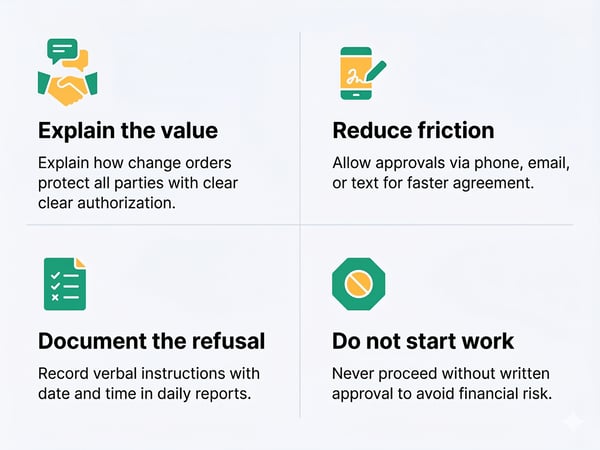
Your contract's change order clause is what gives you options. Use this sequence:
- Explain the value — "I use change orders on every project because it protects both of us. You know exactly what you're authorizing."
- Reduce friction — Offer phone, email, or text. Digital signatures are enforceable in most states. A text reply stating "I agree to CO-003 for $1,450" has legal weight.
- Document the refusal — If a client verbally directs extra work and refuses to sign, log it in your daily report with date and time.
- Don't start the work — If it's not authorized in writing, the financial risk is entirely yours.
For managing change orders, daily reports, and punch lists in one place, see our construction project management software guide for tools with built-in change order workflows.
Relevant Article:Streamline Construction Change Orders with AI and TaskTag
Frequently Asked Questions
Does a change order need to be in writing to be enforceable?
Yes — in most states for residential construction. Many states explicitly require written change orders for home improvement contracts above a dollar threshold. A text message is better than nothing but far weaker than a signed document. Your construction contract template should already state this requirement.
Can I charge for time spent preparing change orders?
Yes. If a scope change requires hours of re-pricing and sub coordination, include a "CO preparation and coordination" line at your standard hourly rate. Most clients won't question it.
What if a client approves verbally but refuses to pay?
Your daily report is your first line of defense. A log entry from the date of verbal approval — noting who said what — is admissible in arbitration and court. Pair with text messages or emails. See our construction daily report template for how to document verbal directives, and our contractor invoice template for the lien rights language that motivates payment.
How do I handle a change order that reduces the contract price?
Exactly the same way as an addition. A deductive CO removes scope and reduces price. Document it identically — clients often expect credits larger than they are (they forget mobilization, supervision, and pre-ordered materials still carry costs). A written credit CO prevents disputes about the credit amount.
Should change orders include overhead and profit markup?
Always. Change order work is not discounted. Mark up at your standard rate (typically 15–25% on residential). Include the markup line explicitly — transparent markup causes less friction than hidden markup does.
Conclusion
Every undocumented scope addition is a gift you're giving away. On a $75,000 renovation with 4 undocumented change orders averaging $3,500 each, that's $14,000 in unrecovered revenue — money that came out of your labor and materials and went nowhere.
Use the template above, make signing the path of least resistance, and submit every change order before the work begins.
For the full contractor documentation stack, see our construction contract template for the master agreement that makes change orders enforceable, and our construction punch list template for the closeout process that accounts for all CO work before final payment is released.
Sources: Buildertrend State of Residential Construction 2024 · Construction industry payment and scope management benchmarks