

 The construction industry is short 500,000 workers in 2026, according to the Associated Builders and Contractors. The average time to fill a skilled trade position has stretched to 42 days. The cost of a bad hire — lost productivity, rework, and replacement — runs 1.5–2x the worker's annual salary.
Most contractors hire reactively: a job comes in, they need bodies, they call whoever answers. That produces high turnover, inconsistent quality, and a crew that can't scale.
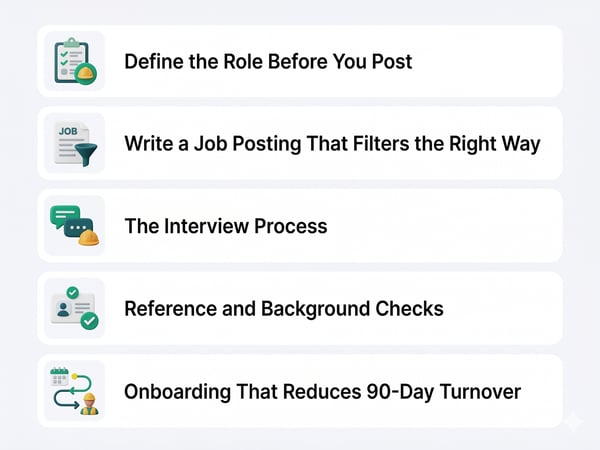
Step 1 — Define the Role Before You Post
Before writing a single word of the listing, answer:
- [ ] What specific tasks will this person do daily?
- [ ] What tools must they operate on Day 1?
- [ ] What certifications are required? (OSHA 10, CDL, trade license)
- [ ] Physical demands? (lifting, heights, confined spaces, weather)
- [ ] Will they supervise anyone?
- [ ] Hours and schedule — early start times, weekend work, travel?
- [ ] Employee (W-2) or subcontractor (1099)?
- [ ] Starting wage range?
Step 2 — Write a Job Posting That Filters the Right Way
Job Posting Template — Field Worker / Laborer
[Company Name] — [Trade/Role Title] Location: [City, State] | Pay: $[X]–$[X]/hour | Type: Full-time, W-2
About Us: [2–3 sentences — how long in business, what you build, why someone would want to work here. Be specific: "We're a residential framing contractor doing 40–60 custom homes per year in [metro]."]
What You'll Do:
- [Specific task 1]
- [Specific task 2]
- [Specific task 3]
What We're Looking For:
- [X] years in [trade] — we will verify this
- Able to lift 80 lbs, work on feet all day
- Reliable transportation to job sites in [area]
- Must pass background check and drug screen
- [Required certifications]
What We Offer:
- $[X]–$[X]/hour depending on experience
- [Benefits — health, 401k, paid holidays]
- Year-round work — we don't lay off in winter
- [Growth path — "Opportunity to move into foreman role within 12–18 months"]
Schedule: Monday–Friday, [start time] AM. Occasional Saturday when needed.
Job Posting Template — Foreman / Lead
Same structure, plus:
What You'll Do:
- Lead a crew of [X] on [project type] projects
- Read and interpret blueprints, specs, and schedules
- Coordinate daily work with superintendent and subs
- Train and mentor junior crew members
- Maintain daily production logs and report to PM
- Enforce safety standards on site
What We're Looking For:
- [X]+ years of [trade], including [X] in a lead or supervisory role
- Proven ability to manage crew and hit production targets
- OSHA 30 preferred; OSHA 10 required
Where to Post
|
Platform |
Best For |
Cost |
|
Indeed |
All trades, all levels |
Free + $50–$200/week to boost |
|
Craigslist |
Local laborers, entry-level |
$25/post |
|
ZipRecruiter |
Mid-level skilled trades |
$300–$500/month |
|
Facebook Jobs |
Local hires, passive candidates |
Free |
|
|
PM, estimators, office roles |
Free + sponsored |
|
Union halls / trade schools |
Apprentices, journeymen |
Free–low cost |
|
Employee referrals |
Best quality hires |
$500–$1,000 referral bonus |
Referred employees have 45% higher 2-year retention than job board hires. Set up a formal referral bonus — $500–$1,000 paid at 90 days is a strong incentive.
Step 3 — The Interview Process
Phone Screen (10 minutes)
- "Tell me your experience in [trade] — what have you worked on?"
- "What tools are you comfortable operating independently?"
- "What's your availability — can you start at [X time]?"
- "Are you open to a background check and drug screen?"
If anything disqualifies them, end here. Don't bring in someone you already know won't work.
In-Person Interview (30–45 minutes)
Skills questions:
- "Walk me through a recent project — what was your role and what did you build?"
- "What tools do you use every day? Which are you most comfortable with?"
- "Have you read blueprints on the job? Walk me through how you'd read a framing plan."
- "What's your process when you get a task you're not sure how to do?"
Reliability and attitude:
- "Tell me about a conflict with a coworker or supervisor. What happened?"
- "What would your last foreman say about you if I called right now?"
- "Construction schedules shift constantly — how do you handle last-minute changes?"
- "What made you leave your last position?"
Culture fit:
- "What kind of work environment do you do your best work in?"
- "How do you prefer to receive feedback when something isn't done right?"
- "Where do you want to be in 3 years?"
Practical skills test: For key hires, a 30-minute paid test at a job site tells you more than any interview. Have them cut and install something simple. You'll see technique, tool handling, and how they handle feedback.
Step 4 — Reference and Background Checks
Reference check script:
- "In what capacity did you work with [candidate] and for how long?"
- "What were their primary tasks? How was their work quality?"
- "How was their attendance and reliability?"
- "Would you rehire [candidate] if you had an opening? Why or why not?"
The rehire question is the most important — references hedge on criticism but answer this honestly.
Background checks: Use FCRA-compliant services (HireRight, Checkr, Sterling). Check criminal history, driving record (if operating vehicles), and employment verification. Convictions only — not arrests — and only for crimes relevant to the role.
Drug screening: Standard 5-panel urine test. In states where marijuana is legal, consult your attorney on handling positive marijuana results.
1099 vs. W-2: Getting Classification Right
|
Factor |
Points to Employee (W-2) |
Points to Contractor (1099) |
|
Control |
You direct how/when/where |
They control their methods |
|
Equipment |
You provide tools |
They use their own |
|
Schedule |
You set their hours |
They set their own |
|
Exclusivity |
They work only for you |
They work for multiple clients |
|
Payment |
Hourly or salary |
By job or project |
If you tell someone when to show up, where to go, what to do, and provide their tools — they are an employee, regardless of what your contract says.
Misclassification consequences: Back payroll taxes for 3 years | Unpaid workers' comp premiums + penalties | State fines of $5,000–$25,000 per misclassified worker | Personal liability for the owner
Step 5 — Onboarding That Reduces 90-Day Turnover
Half of all construction worker turnover happens in the first 90 days. Most is preventable.
Day 1 Paperwork (complete before they touch a tool):
- [ ] Form W-4
- [ ] Form I-9 — verify documents; complete within 3 business days of hire
- [ ] State withholding form
- [ ] Direct deposit authorization
- [ ] Emergency contact form
- [ ] Employee handbook acknowledgment
- [ ] Safety plan reviewed and signed
Day 1 Safety Orientation:
- [ ] PPE issued and fit confirmed
- [ ] Emergency procedures reviewed
- [ ] Site hazards discussed
- [ ] Assembly point identified
Day 1 Site Introduction:
- [ ] Introduced to foreman and crew by name
- [ ] Site tour: staging, first aid, fire extinguisher, parking
- [ ] Call-out procedure explained
- [ ] Pay schedule and timing confirmed
- [ ] 30-day and 90-day check-in scheduled
Week 1 — Assign a buddy. Pair new hires with an experienced crew member for the first week. This is the single highest-impact action to reduce early turnover.
Hiring and Retention Benchmarks
[SVG table: Time to fill 42 days → best-in-class under 21 | Annual turnover 56% → best-in-class under 25% | 90-day turnover 28% → best-in-class under 10% | Cost to replace $8K–$15K | % hired from referrals 18% → best-in-class 40%+]
Annual industry turnover of 56% costs a 10-person crew $80,000–$150,000/year in replacement costs.
What Actually Reduces Turnover
.jpg?width=600&height=450&name=2%20(24).jpg)
Top reasons field workers leave (2025 AGC survey):
- Poor relationship with direct supervisor — 41%
- Inconsistent work / layoffs — 31%
- Better pay elsewhere — 28%
- Unsafe or disorganized job site — 19%
- No path to advancement — 17%
What this means:
- Train your foremen — your best carpenter is not automatically your best foreman
- Provide year-round work — seasonal layoffs push good workers to other industries permanently
- Pay market or above — check competitor pay annually; losing a worker to $2/hour more after 6 months of training costs far more than the raise
- Create visible advancement paths — laborer → carpenter → lead → foreman; name it, set criteria, follow through
Revelant Article:The "Zero-Friction" Hires Guide: Transforming Field Onboarding with ChatGPT + TaskTag

-1.png?height=200&name=2%20(6)-1.png)
.png?height=200&name=1%20(18).png)