---
title: "Construction WIP Report: How to Track Work in Progress and Avoid Over/Under Billing"
description: Learn how to prepare a construction WIP report, calculate percentage of completion, prevent over/under billing, and improve financial forecasting for contractors.
image: https://blog.tasktag.com/hubfs/1%20-%202026-07-01T194308.622.jpg
---
[Skip to content](https://blog.tasktag.com/construction-wip-report-track-work-in-progress-avoid-over-under-billing#main-content)
[](https://www.tasktag.com)
- [Features](https://tasktag.com/features/photo-documentation/)
- [Pricing](https://tasktag.com/pricing)
- [Compare](https://tasktag.com/compare/companycam/)
- [Blog](https://blog.tasktag.com/)
- [Resources](https://blog.tasktag.com/product)
Open main navigation
Close main navigation
- [Features](https://tasktag.com/features/photo-documentation/)
- [Pricing](https://tasktag.com/pricing)
- [Compare](https://tasktag.com/compare/companycam/)
- [Blog](https://blog.tasktag.com/)
- [Resources](https://blog.tasktag.com/product)
- [Start For Free](https://app.tasktag.com/register/signup-with-email?_gl=1*1ic34dn*_ga*MjU5NjU5OTI3LjE3NzM5Nzc1Nzg.*_ga_B535V4B5ZV*czE3NzczMzU3MjgkbzQkZzAkdDE3NzczMzU3MjgkajYwJGwwJGgw)
[Start For Free](https://app.tasktag.com/register/signup-with-email?_gl=1*1ic34dn*_ga*MjU5NjU5OTI3LjE3NzM5Nzc1Nzg.*_ga_B535V4B5ZV*czE3NzczMzU3MjgkbzQkZzAkdDE3NzczMzU3MjgkajYwJGwwJGgw)
Jul 1, 2026, 8:20:00 PM
# Construction WIP Report: How to Track Work in Progress and Avoid Over/Under Billing
[Kang Shen](https://blog.tasktag.com/author/kang-shen)
Share: [facebook-f icon](http://www.facebook.com/share.php?u=https://blog.tasktag.com/construction-wip-report-track-work-in-progress-avoid-over-under-billing) [linkedin-in icon](http://www.linkedin.com/shareArticle?mini=true&url=https://blog.tasktag.com/construction-wip-report-track-work-in-progress-avoid-over-under-billing) [Twitter icon](https://twitter.com/intent/tweet?url=https://blog.tasktag.com/construction-wip-report-track-work-in-progress-avoid-over-under-billing) [pinterest-p icon](http://pinterest.com/pin/create/link/?url=https://blog.tasktag.com/construction-wip-report-track-work-in-progress-avoid-over-under-billing) [envelope icon](mailto:?body=https://blog.tasktag.com/construction-wip-report-track-work-in-progress-avoid-over-under-billing)
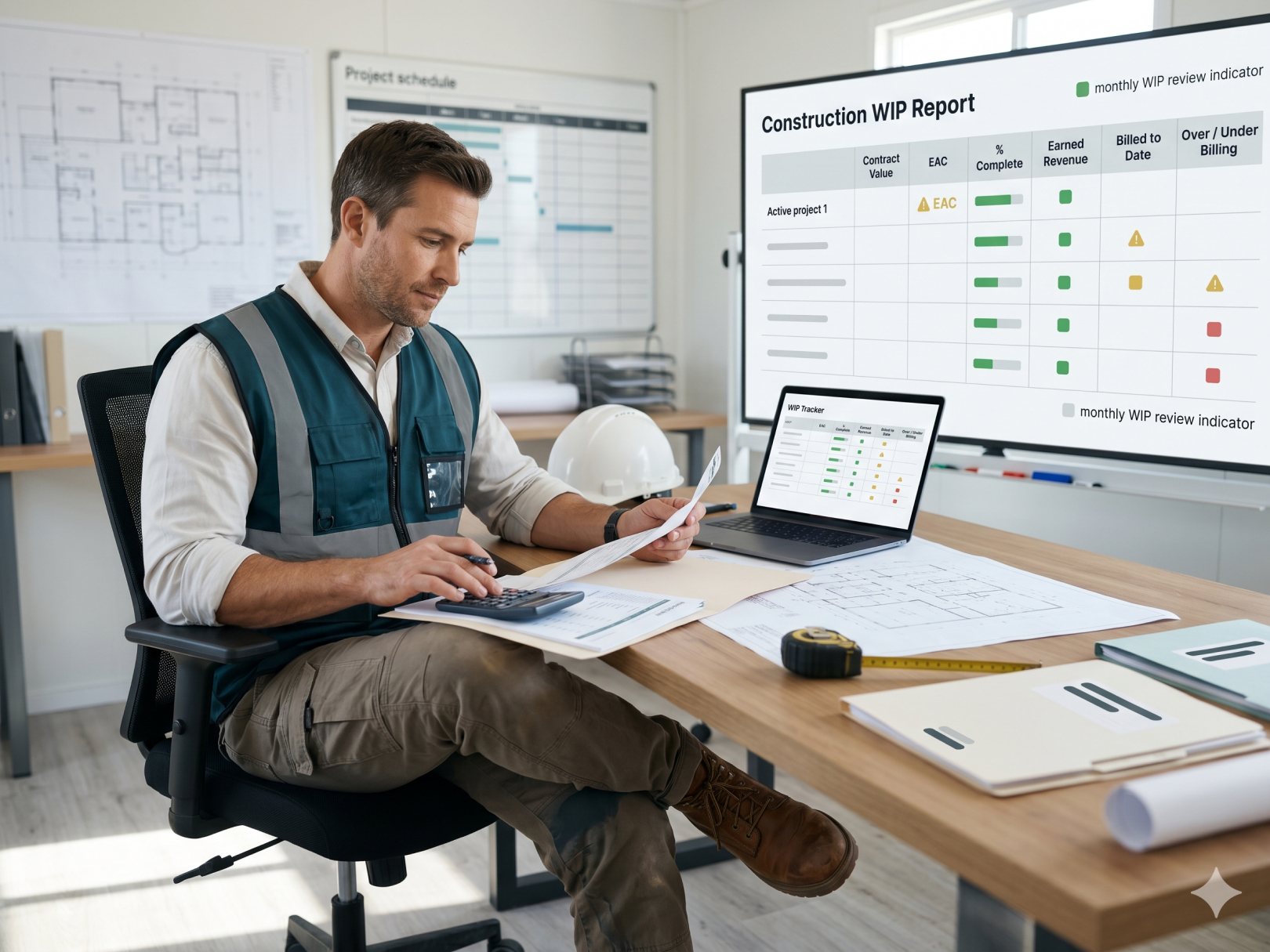
The construction WIP report — Work in Progress schedule — separates contractors who understand their financial position from those who are surprised by their own numbers.
Without a WIP schedule, your P&L reflects cash movement, not true economic performance.
Contractors who want tighter financial visibility often combine monthly WIP reporting with stronger documentation and field reporting systems. If you’re building that foundation, explore this [**construction project management guide**](https://blog.tasktag.com/mastering-construction-project-management) to understand how operational systems support financial accuracy.
## **What the Construction WIP Report Measures**
The construction WIP report answers one question per active project:
Have you billed more or less than you’ve earned?
### **Over-billed**
You’ve billed more than you’ve earned based on percentage of completion.
This appears as a liability on your balance sheet.
Moderate over-billing is healthy. Extreme over-billing signals schedule or cost control problems.
### **Under-billed**
You’ve completed more work than you’ve billed.
This appears as an asset on your balance sheet.
Persistent under-billing creates cash flow strain and weakens bank and surety confidence.
Clear [**jobsite photos & daily progress tracking**](https://tasktag.com/features/photo-documentation/) help validate earned revenue when billing disputes arise.
## **The Percentage of Completion (POC)**
Most contractors use the cost-to-cost method:
POC = Costs to date ÷ Estimated cost at completion (EAC)
Example:
$180,000 spent on a $360,000 EAC project = 50% complete.
The critical input is the revised EAC — not the original budget.
Failing to update EAC overstates profit and artificially inflates recognized revenue.
Project managers who consistently update budgets inside structured [**construction management tools & features**](https://blog.tasktag.com/product)reduce WIP distortion.
Update EAC every month. No exceptions.
## **The WIP Calculation — Step by Step**
**.jpg?width=600&height=450&name=2%20(28).jpg)**
For each active project:
- Earned Revenue = Contract Value × POC
- Actual Billings = Total billed to owner
- Over/Under Billing = Earned Revenue − Billings
- Recognized Profit = Estimated Total Profit × POC
### **Full example — Project A (retail buildout):**
- Contract value: $480,000 | EAC: $392,000 | Estimated profit: $88,000
- Costs to date: $235,200 | POC: 60%
- Earned revenue: $288,000 | Billed: $310,000
- **Over-billed: $22,000** | Recognized profit: $52,800
### **WIP Schedule Template Structure**
**\[Company Name\] — Work in Progress Schedule — As of: \[Month End\]**
| **Project** | **Contract Value** | **EAC** | **Est. Profit** | **Costs to Date** | **% Complete** | **Earned Revenue** | **Billed to Date** | **Over-Billed** | **Under-Billed** |
| --- | --- | --- | --- | --- | --- | --- | --- | --- | --- |
| Project A | $480,000 | $392,000 | $88,000 | $235,200 | 60% | $288,000 | $310,000 | $22,000 | — |
| Project B | $720,000 | $576,000 | $144,000 | $172,800 | 30% | $216,000 | $195,000 | — | $21,000 |
| Project C | $285,000 | $237,000 | $48,000 | $189,600 | 80% | $228,000 | $228,000 | — | — |
| Project D | $1,100,000 | $880,000 | $220,000 | $88,000 | 10% | $110,000 | $143,000 | $33,000 | — |
| Project E | $340,000 | $272,000 | $68,000 | $108,800 | 40% | $136,000 | $119,000 | — | $17,000 |
| **TOTALS** | **$2,925,000** | **$2,357,000** | **$568,000** | **$794,400** | **34%** | **$978,000** | **$995,000** | **$55,000** | **$38,000** |
**Net WIP position: Over-billed by $17,000** ($55K over − $38K under)
Contractors managing multiple crews across projects often improve accuracy by using [**project management software for general contractors**](https://tasktag.com/for/general-contractors/)that centralizes cost tracking and documentation.
## **How the WIP Report Connects to Financial Statements**
\[SVG: Flow diagram — under-billed → current asset on balance sheet → increases reported revenue; over-billed → current liability → decreases reported revenue\]
### **WIP-adjusted P&L example:**
| | **Cash-Basis P&L** | **WIP-Adjusted P&L** |
| --- | --- | --- |
| Billed revenue | $420,000 | $420,000 |
| WIP adjustment (+$38K under-billed) | — | +$38,000 |
| **Reported revenue** | **$420,000** | **$458,000** |
| Direct costs | $336,000 | $336,000 |
| **Gross margin** | **20.0%** | **26.6%** |
The WIP-adjusted P&L reveals that this month's true gross margin was 26.6% — not 20%. The difference is $38,000 in earned revenue sitting on job sites, not yet billed.
If billing is delayed due to incomplete documentation, implementing structured [**construction photo documentation software**](https://tasktag.com/features/photo-documentation/) can accelerate draw approvals and reduce under-billing.
## **Common Construction WIP Report Mistakes**
**.jpg?width=600&height=450&name=2%20(29).jpg)**
1. **Not updating EAC every month.** The most damaging error. Using the original budget when a job is running over overstates POC and overstates recognized profit — recording earnings that don't exist.
1. **Calculating POC as billings ÷ contract value.** This is circular — it assumes billing timing equals progress. Always use costs ÷ EAC.
1. **Not recognizing anticipated losses immediately.** If updated EAC exceeds contract value, you must recognize the full estimated loss in the current period — not spread it out. GAAP requires this; there's no deferring a loss job.
1. **Only running WIP at year-end.** A WIP produced only for the accountant is useless for management. By year-end, the project is often done — nothing can be managed. Monthly WIP catches problems at 30–60% completion when you can still act.
1. **Treating WIP as a purely accounting exercise.** The WIP report tells you which projects are running over budget, which have billing gaps, and where your portfolio's real profitability lies. Read it.
If you want deeper financial management insights, review these [**construction management resources**](https://blog.tasktag.com/)for contractors scaling operations.
## **Recognizing a Loss Job Early**
Early EAC updates expose loss jobs at 30–60% completion.
That creates time to:
- Submit change orders
- Rebid subcontract scope
- Reduce overhead exposure
Late recognition leaves you reacting after completion.
## **How Banks and Sureties Use Your Construction WIP Report**
Banks evaluate:
- Under-billed positions
- Extreme over-billing
- Hidden loss jobs
Sureties evaluate:
- Active profitability
- Aggregate workload
- Accuracy of reporting
If you’re preparing for larger bonded work, reviewing real contractor growth examples like this [**construction project management case study**](https://tasktag.com/case-studies/holdfast-constructions/) provides insight into operational discipline.
You can also study this[**construction delivery tracking case study**](https://tasktag.com/case-studies/isc-building-materials/) to understand how operational visibility improves financial forecasting
## **What Your Accountant Needs Monthly**
For each active project:
| **Field** | **Source** |
| --- | --- |
| Contract value (including approved COs) | Contract + CO log |
| Revised EAC | **PM update — critical** |
| Actual costs to date | Job cost report |
| Total billed to date | Draw log / AR aging |
The bottleneck is always the EAC update. Build the habit: on the last business day of each month, ask each PM for one number — their cost-to-complete estimate for each active project. 10 minutes per PM. Makes your entire WIP accurate.
If field teams struggle to provide accurate updates, implementing[**daily field reports for roofing contractors**](https://tasktag.com/features/photo-documentation/) or trade-specific workflows can tighten reporting discipline.
## **Monthly Construction WIP Checklist**
### **Last week of each month:**
- \[ \] Request PM cost-to-complete estimates for all active projects
- \[ \] Pull actual costs to date from job cost reports
- \[ \] Pull total billings to date from AR/draw log
- \[ \] Update EAC for any projects with changed conditions
- \[ \] Calculate POC, earned revenue, and over/under billing per project
- \[ \] Recognize any anticipated losses immediately
- \[ \] Submit draw applications for significantly under-billed projects
- \[ \] Forward inputs to accountant for balance sheet and P&L adjustment
### **Monthly management questions:**
- \[ \] Any projects with EAC exceeding contract value? → Recognize full loss
- \[ \] Any projects over-billed by more than 15% of contract? → Monitor closely
- \[ \] Any projects under-billed by more than 10%? → Submit billing immediately
- \[ \] Is total recognized profit trend improving or deteriorating?
### **For bank and surety submissions:**
- \[ \] WIP current as of last month-end with EAC updated
- \[ \] All active projects included — no omissions
- \[ \] Backlog schedule attached (awarded, not yet started)
## **Final Thoughts**
The construction WIP report is not an accounting exercise.
It is an operational control tool.
Contractors who update WIP monthly:
- Forecast profit accurately
- Improve cash flow
- Increase bank confidence
- Strengthen surety relationships
If you want stronger field-to-finance alignment:
- Explore [**TaskTag pricing plans**](https://tasktag.com/pricing)
- Or [**start your free TaskTag account**](https://app.tasktag.com/register/signup-with-email)
- You can also [**book a TaskTag demo**](https://blog.tasktag.com/demo) to see how reporting flows from the field to financial dashboards.
- To learn more about the company behind the platform, visit [**About TaskTag**.](https://tasktag.com/about)
[**Related Resources**](https://tasktag.com/about)
- [Contractor Profit and Loss Statement](https://claude.ai/blog/contractor-profit-and-loss-statement) — how WIP adjustments change reported revenue and gross margin
- [Construction Job Costing](https://claude.ai/blog/construction-job-costing) — the cost tracking system that feeds accurate costs-to-date into every WIP calculation
- [Construction Bonds Guide](https://claude.ai/blog/construction-bonds-guide) — why sureties require a current WIP schedule and what they look for
- [Construction Cash Flow Management](https://claude.ai/blog/construction-cash-flow-management) — how under-billed positions represent earned-but-uncollected cash
- [Construction Overhead and Profit](https://claude.ai/blog/construction-overhead-and-profit) — overhead allocation that must be covered for each project to recognize true profit
- [Construction Budget Template](https://claude.ai/blog/construction-budget-template) — original project budgets that become the baseline EAC used in WIP calculations
- [Construction Payment Schedule Template](https://claude.ai/blog/construction-payment-schedule-template) — draw schedule structure that minimizes chronic under-billing
### Ready to explore how TaskTag can transform your construction projects?
Start your free trial today and see the difference!
[Start Using Tasktag](https://onelink.to/tasktagapp)
[tasktag](https://blog.tasktag.com/tag/tasktag), [Construction Photo Documentation Software](https://blog.tasktag.com/tag/construction-photo-documentation-software), [Job costing](https://blog.tasktag.com/tag/job-costing), [contractor financial management](https://blog.tasktag.com/tag/contractor-financial-management), [CompanyCam alternative](https://blog.tasktag.com/tag/companycam-alternative), [construction WIP report](https://blog.tasktag.com/tag/construction-wip-report)
## Related posts
[.jpg?height=200&name=1%20(51).jpg)](https://blog.tasktag.com/how-to-write-pressure-washing-contract-template)
[tasktag](https://blog.tasktag.com/tag/tasktag), [AI in construction](https://blog.tasktag.com/tag/ai-in-construction), [tasktag for contractors](https://blog.tasktag.com/tag/tasktag-for-contractors), [toolbox talk tracking](https://blog.tasktag.com/tag/toolbox-talk-tracking), [free time tracking](https://blog.tasktag.com/tag/free-time-tracking), [pressure washing contracts](https://blog.tasktag.com/tag/pressure-washing-contracts), [construction](https://blog.tasktag.com/tag/construction)
## [Pressure Washing Contracts Template: What to Include, Why It Matters & How to Win More Jobs in 2026](https://blog.tasktag.com/how-to-write-pressure-washing-contract-template)
[Neil Lucas](https://blog.tasktag.com/author/neil-lucas)
Mar 26, 2026, 1:00:52 AM
[Read more](https://blog.tasktag.com/how-to-write-pressure-washing-contract-template)
[.jpg?height=200&name=1%20(19).jpg)](https://blog.tasktag.com/pressure-washing-contract-template)
[general contractor software](https://blog.tasktag.com/tag/general-contractor-software), [construction photo app](https://blog.tasktag.com/tag/construction-photo-app), [service agreement](https://blog.tasktag.com/tag/service-agreement), [pressure washing contract](https://blog.tasktag.com/tag/pressure-washing-contract), [pressure washing agreement](https://blog.tasktag.com/tag/pressure-washing-agreement), [contractor contract template](https://blog.tasktag.com/tag/contractor-contract-template), [estimate to contract](https://blog.tasktag.com/tag/estimate-to-contract)
## [Pressure Washing Contracts Template: A Practical, Copy‑Paste Agreement (With Clauses That Prevent Disputes)](https://blog.tasktag.com/pressure-washing-contract-template)
[Kang Shen](https://blog.tasktag.com/author/kang-shen)
Mar 12, 2026, 9:56:49 PM
What a Pressure Washing Contract Should Cover A clear pressure washing contract protects both you...
[Read more](https://blog.tasktag.com/pressure-washing-contract-template)
[](https://blog.tasktag.com/construction-time-card-laws-by-state)
[tasktag](https://blog.tasktag.com/tag/tasktag), [Construction Time Tracking](https://blog.tasktag.com/tag/construction-time-tracking), [prevailing wage compliance](https://blog.tasktag.com/tag/prevailing-wage-compliance), [roofing contractor software](https://blog.tasktag.com/tag/roofing-contractor-software), [certified payroll](https://blog.tasktag.com/tag/certified-payroll), [CompanyCam comparison](https://blog.tasktag.com/tag/companycam-comparison)
## [Construction Time Card Laws by State: Overtime, Prevailing Wage, and Certified Payroll](https://blog.tasktag.com/construction-time-card-laws-by-state)
[Kang Shen](https://blog.tasktag.com/author/kang-shen)
Jul 9, 2026, 1:11:45 AM
The Department of Labor recovered $274 million in back wages from construction employers in fiscal...
[Read more](https://blog.tasktag.com/construction-time-card-laws-by-state)
- [Features](https://tasktag.com/features/photo-documentation/)
- [Pricing](https://tasktag.com/pricing)
- [Compare](https://tasktag.com/compare/companycam/)
- [Blog](https://blog.tasktag.com)
- [Resources](https://blog.tasktag.com/product)
---
[](https://app.tasktag.com)
[facebook-f icon](https://www.facebook.com/TaskTagApp/) [Follow us on LinkedIn](https://www.linkedin.com/company/tasktagapp/) [Follow us on Twitter/X](https://www.twitter.com/tasktag/) [Follow Us on Instagram](https://www.instagram.com/tasktagapp/) [Check Out Our YouTube](https://www.youtube.com/@tasktagapp)
2410 Polk St, Houston, TX 77007
Copyright © 2026
```json
{
"@context" : "https://schema.org",
"@type" : "BlogPosting",
"author" : {
"@type" : "Person",
"name" : "Kang Shen",
"url" : "https://blog.tasktag.com/author/kang-shen"
},
"dateModified" : "2026-07-02T01:20:00.948Z",
"datePublished" : "2026-07-02T01:20:00.000Z",
"headline" : "Construction WIP Report: How to Track Work in Progress and Avoid Over/Under Billing",
"image" : [ "https://blog.tasktag.com/hubfs/1%20-%202026-07-01T194308.622.jpg" ],
"mainEntityOfPage" : {
"@id" : "https://blog.tasktag.com/construction-wip-report-track-work-in-progress-avoid-over-under-billing",
"@type" : "WebPage"
},
"publisher" : {
"@type" : "Organization",
"logo" : {
"@type" : "ImageObject",
"url" : "https://blog.tasktag.com/hubfs/tasktag-logo.svg"
},
"name" : "TaskTag"
}
}
```