

A vague scope of work is the root cause of most construction disputes. The Construction Industry Institute found that poorly defined scope is responsible for 50% of all project cost overruns. A precise, written scope eliminates ambiguity before it becomes a change order argument or a payment dispute.
Key Takeaways
- Scope gaps cause 50% of construction cost overruns — more than any other single factor (CII)
- A written SOW reduces change orders by up to 40% on residential projects
- The exclusions section is as important as the inclusions — undefined work is always assumed included by the client
- SOW documents are referenced in contracts, proposals, and change orders — write them to stand alone
What Is a Construction Scope of Work?
A construction scope of work (SOW) defines exactly what work will and will not be performed on a project — materials, methods, quantities, responsibilities, and boundaries.
A strong SOW answers three questions for every element:
- What exactly will be done?
- Who is responsible (contractor, sub, owner)?
- What is not included?
When to Write a Scope of Work
|
Project Type |
When to Write SOW |
|
Residential remodel |
Before proposal is issued |
|
New construction |
During pre-construction, before contract |
|
Specialty trade work |
Before subcontractor is engaged |
|
Change order |
Every time — even small additions |
|
Subcontractor agreement |
Always — as an exhibit to the sub contract |
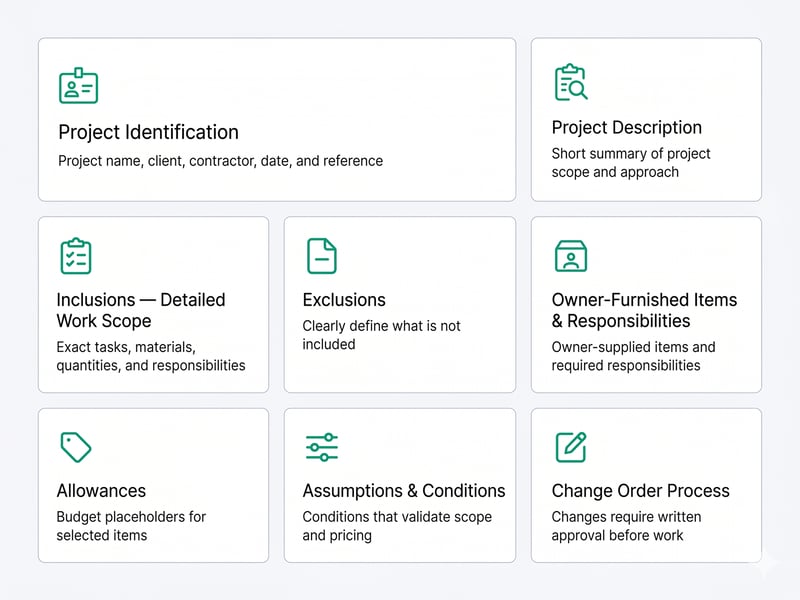
The 8 Sections of a Construction Scope of Work
1. Project Identification
- Project name and address
- Owner/client name
- Contractor name and license number
- Date and revision number (SOW Rev 0, Rev 1…)
- Reference to associated contract or proposal number
2. Project Description
2–4 sentences confirming the project, approach, and basis for the document.
Example: "This scope covers the complete renovation of the first-floor bathroom at 812 Clover Lane, including full demolition, new waterproofing, tile, fixtures, vanity, and lighting. Work is based on the client-selected finish schedule dated April 20, 2026."
3. Inclusions — Detailed Work Scope
For each trade or phase:
- Specific tasks (not categories — "install 4×12 subway tile on shower walls to ceiling" not "tile work")
- Materials and specs (brand, model, grade)
- Quantities (SF, LF, units)
- Who supplies (contractor-furnished, owner-furnished, allowance)
4. Exclusions
Everything not listed in Section 3 that a client might assume is included:
- Conditions hidden behind walls/floors not visible at proposal time
- Asbestos, lead paint, or mold remediation
- Structural engineering or design fees
- Permit fees (if billed separately)
- Owner-furnished materials
- Work outside areas specifically listed
5. Owner-Furnished Items and Responsibilities
- Materials the owner is supplying
- Site access requirements
- Selection deadlines (tile, fixtures, cabinets) — with dates
6. Allowances
|
Item |
Allowance |
What It Covers |
|
Floor tile |
$8.00/SF installed |
Material + labor |
|
Plumbing fixtures |
$1,200 per bathroom |
Owner selects; contractor installs |
|
Light fixtures |
$350 per fixture |
Owner selects; contractor installs |
Allowance overages are change orders. State this explicitly.
7. Assumptions and Conditions
Conditions under which scope and pricing are valid:
Example: "Scope assumes existing subfloor is structurally sound and level within 3/16" over 10'. Any subfloor replacement will be documented as a change order."
8. Change Order Process
"Any additions, deletions, or substitutions require a written change order signed by both parties before work proceeds. Verbal authorizations are not valid."
Copy-Ready Construction Scope of Work Template
CONSTRUCTION SCOPE OF WORK
Project Name: [Project Name / Address]
Owner / Client: [Client Full Name]
Contractor: [Your Company Name] | License #: [Number]
Date: [Date] | Revision: [Rev 0]
Reference: [Proposal # or Contract #]
─────────────────────────────────────────────
- PROJECT DESCRIPTION
─────────────────────────────────────────────
[2–4 sentences — project, approach, basis for document]
─────────────────────────────────────────────
- SCOPE OF WORK — INCLUSIONS
─────────────────────────────────────────────
DEMOLITION
- [Specific task with disposal noted]
- [Specific task]
FRAMING / ROUGH CARPENTRY
- [Specific task with drawing reference if applicable]
ELECTRICAL
- [Specific task — note permit requirement]
PLUMBING
- [Specific task — note permit requirement]
DRYWALL
- [Specific task — level of finish specified]
TILE
- [Specific task — material spec, area, grout]
- Tile allowance: $[X]/SF installed — see Section 5
PAINTING
- [Specific task — primer + 2 coats, sheen, area]
FIXTURES AND EQUIPMENT
- [Each item, model if known, who supplies]
CLEANUP AND DISPOSAL
- Daily cleanup; final broom-clean at completion
- Haul-off of all contractor-generated debris
─────────────────────────────────────────────
- EXCLUSIONS — NOT INCLUDED IN THIS SCOPE
─────────────────────────────────────────────
- Conditions concealed behind existing surfaces not visible at time
of this document
- Asbestos, lead paint, or mold testing and remediation
- Structural engineering or design fees
- Permit fees (billed at cost, if applicable)
- Work outside areas identified in Section 2
- [Project-specific exclusions]
─────────────────────────────────────────────
- OWNER-FURNISHED ITEMS AND RESPONSIBILITIES
─────────────────────────────────────────────
Owner will supply: [Item list]
Owner responsibilities:
- Site access: [days/hours]
- All material selections completed by: [date]
- Rooms cleared prior to: [start date]
─────────────────────────────────────────────
- ALLOWANCES
─────────────────────────────────────────────
Floor tile: $[X]/SF installed
Plumbing fixtures: $[X] per bathroom
Light fixtures: $[X] per fixture
[Other]: $[X] — [description]
Overages billed as change orders at cost.
─────────────────────────────────────────────
- ASSUMPTIONS AND CONDITIONS
─────────────────────────────────────────────
- [Existing condition assumed]
- [Code compliance assumption]
- [Structural/access assumption]
Differing conditions will be documented as change orders.
─────────────────────────────────────────────
- CHANGE ORDER PROCESS
─────────────────────────────────────────────
Any additions, deletions, or substitutions require a written,
signed change order before work proceeds.
Verbal authorizations do not modify this scope.
─────────────────────────────────────────────
- DOCUMENT CONTROL
─────────────────────────────────────────────
This SOW is Revision [0] dated [Date].
Supersedes all prior verbal or written scope discussions.
Incorporated by reference into [Contract / Proposal #].
Prepared by: _____________________ Date: ___________
Accepted by: _____________________ Date: ___________
Relevant Article:Home Remodeling Business Plan: The Complete Step-by-Step Guide for 2026
How the SOW Connects to Other Documents
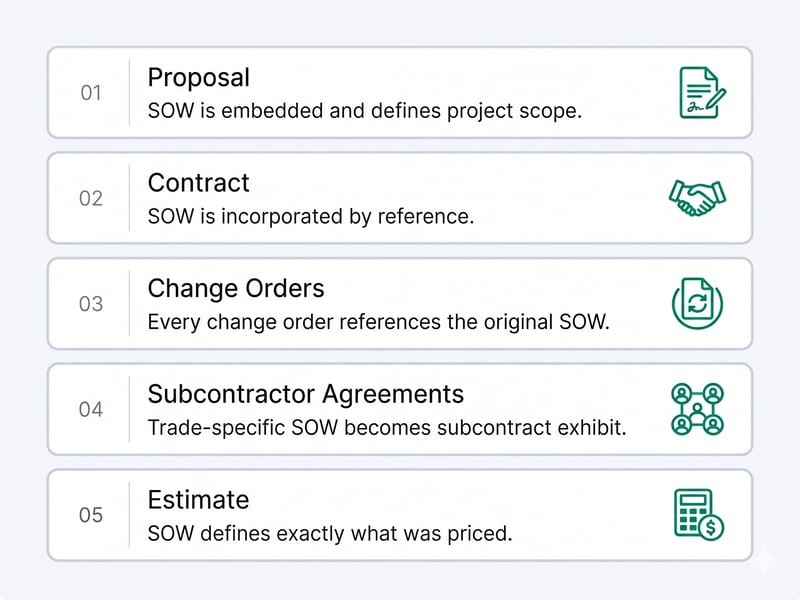
- Proposal — SOW is embedded in your proposal → how to write a construction proposal
- Contract — SOW is incorporated by reference → construction contract template
- Change orders — every CO references the original SOW → construction change order template
- Subcontractor agreements — trade-specific SOW becomes a sub exhibit → how to manage subcontractors
- Estimate — SOW defines what was priced → how to estimate construction costs
Sources: Construction Industry Institute · NAHB Remodeling Market Survey 2025 · AGC Project Delivery Survey 2024
.jpg?height=200&name=3%20(17).jpg)