
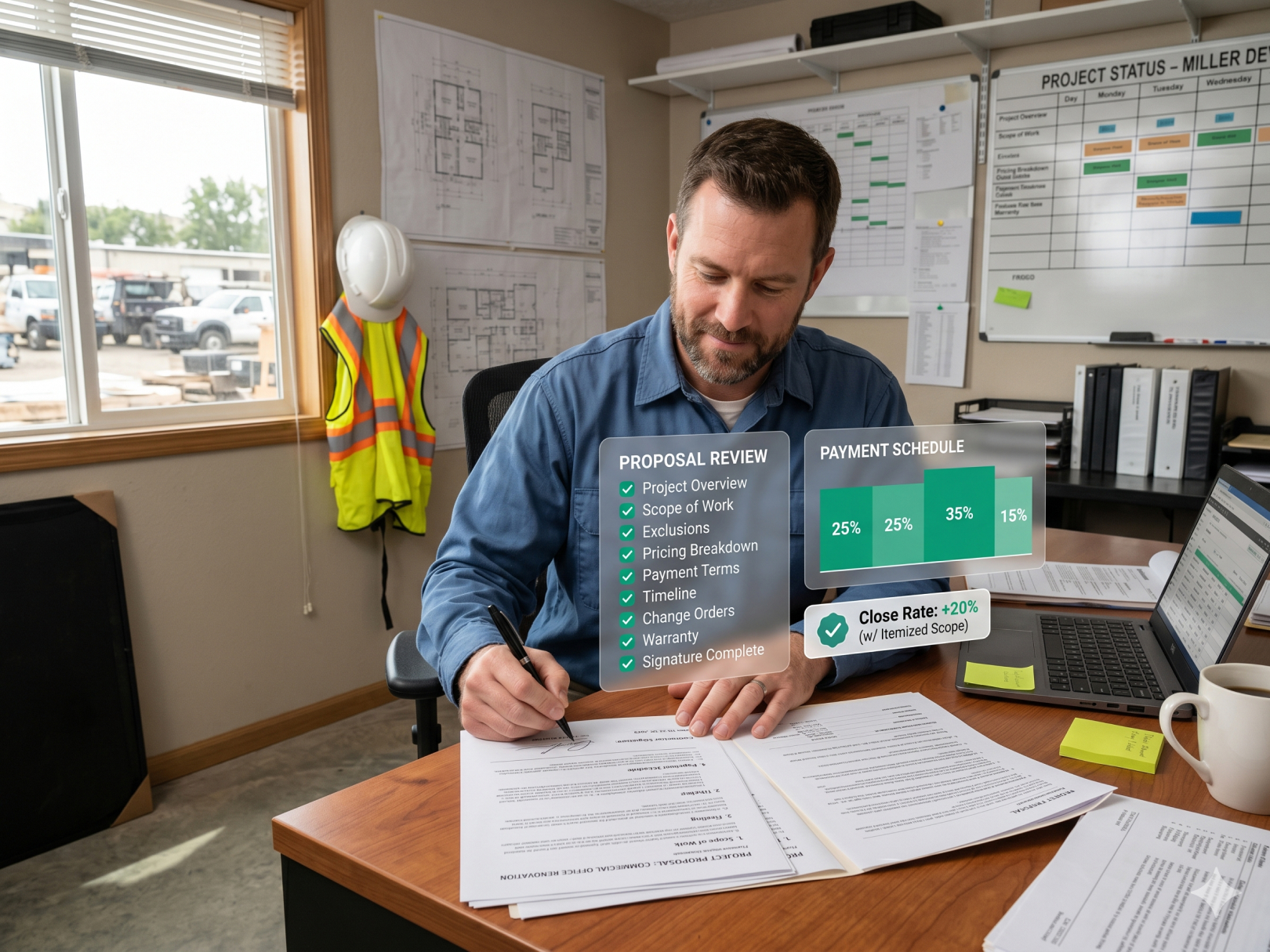
A professional construction proposal is the document that turns an interested homeowner or developer into a signed client. Yet most contractors lose jobs not because of price — but because their proposal fails to communicate value, scope clarity, or professionalism. Studies by the Construction Industry Institute show that projects with clearly defined scopes at proposal stage experience 50% fewer change orders and significantly higher client satisfaction scores.
Key Takeaways
- Proposals with itemized scope and clear exclusions win at higher rates than lump-sum bids
- The average residential contractor closes 30–45% of proposals — a complete template can push that above 50%
- Missing terms (payment schedule, change order process, warranty) are the #1 source of post-contract disputes
- A proposal is not a contract — but written correctly, a signature line makes it one
What Is a Construction Proposal?
A construction proposal is a written offer defining scope, pricing, schedule, and terms for a specific project. It bridges the estimating conversation and the signed contract. Done well, it communicates professionalism, prevents scope creep, and gives the client everything they need to say yes.
A proposal becomes a contract when both parties sign. Many contractors combine both into one document — provided all required clauses are included. See our construction contract template for the full clause set.
Construction Proposal vs. Bid vs. Estimate
|
Document |
Detail Level |
Binding? |
Best For |
|
Rough estimate |
Low — ballpark range |
No |
Early conversations |
|
Bid |
Medium — total price |
Sometimes |
Competitive bid situations |
|
Proposal |
High — scope + price + terms |
When signed |
Residential and negotiated work |
|
Contract |
Complete |
Yes |
Execution stage |
For the estimating framework that feeds your proposal numbers, see our how to estimate construction costs guide.
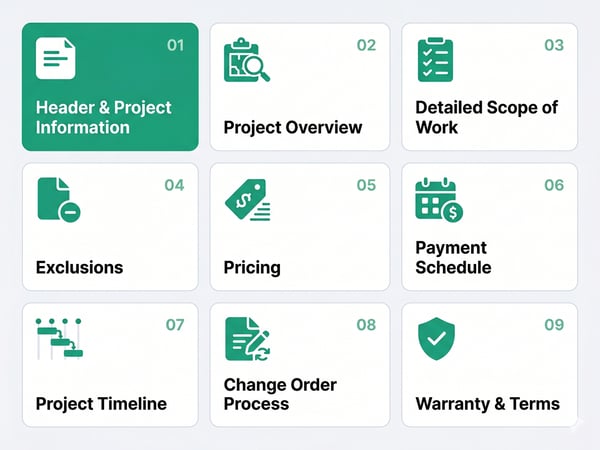
The 9 Sections Every Construction Proposal Needs
1. Header and Project Information
- Contractor name, license number, contact info
- Client name and property address
- Proposal number and date issued
- Expiration date (15–30 days — always include one)
2. Project Overview
One to three sentences confirming what the project is and the agreed goals — proves you understood the client's request correctly.
3. Detailed Scope of Work
The most important section. Specify exactly what you will do, materials and brands where relevant, quantities, and who supplies what. Allowances should be defined explicitly (e.g., "tile allowance: $6/SF supplied; overages billed at cost").
4. Exclusions
List what is not included:
- Conditions behind walls not visible at proposal time
- Permit fees (if billed separately)
- Owner-supplied materials
- Engineering or design fees
- Work in areas not specifically listed
5. Pricing
|
Line Item |
Cost |
|
Demolition and disposal |
$X,XXX |
|
Framing and rough carpentry |
$X,XXX |
|
Electrical |
$X,XXX |
|
Plumbing |
$X,XXX |
|
Insulation and drywall |
$X,XXX |
|
Finish carpentry and trim |
$X,XXX |
|
Painting |
$X,XXX |
|
Flooring |
$X,XXX |
|
Cabinetry and countertops |
$X,XXX |
|
Project management and supervision |
$X,XXX |
|
Total Proposal Price |
$XX,XXX |
Never show a single lump sum with no breakdown — clients with no visibility into the number will always think it's too high.
6. Payment Schedule
|
Milestone |
Amount |
Timing |
|
Contract signing / mobilization |
25–30% |
Before work begins |
|
Rough-in complete |
25–30% |
Upon inspection pass |
|
Substantial completion |
25–30% |
When punch list is issued |
|
Final payment |
10–20% |
Upon punch list sign-off |
For payment terms that minimize slow pays, see our contractor invoice template.
7. Project Timeline
State estimated start, duration, and substantial completion date. Include dependencies (permit approval, owner selections, long-lead items) and your right to adjust if client-caused delays occur.
8. Change Order Process
Every proposal needs this paragraph:
"Any work outside the scope described in this proposal will be documented in a written change order, signed by both parties before work proceeds. Change orders are priced at cost plus [X]% overhead and profit. Verbal authorizations are not binding."
See our construction change order template for the full process.
9. Warranty and Terms
- Workmanship warranty: 1–2 years (labor only, not manufacturer defects)
- Dispute resolution: Mediation before litigation
- Lien rights notice: Contractor retains right to file mechanics lien if unpaid
- Insurance: GL and workers' comp confirmation
- Signature block: Client signature, date, printed name
(SVG: Proposal close rate by sections included — bar chart)
(SVG: Top reasons contractors lose proposals — horizontal bar)
Copy-Ready Construction Proposal Template
CONSTRUCTION PROPOSAL
Contractor: [Your Company Name]
License #: [State License Number]
Address: [Your Address]
Phone: [Your Phone] | Email: [Your Email]
Client: [Client Full Name]
Property Address: [Job Site Address]
Proposal #: [YYYY-####]
Date Issued: [Date]
Valid Until: [Date + 21 days]
────────────────────────────────────────────
PROJECT OVERVIEW
[One paragraph describing the project scope based on your site visit
and client conversations.]
─────────────────────────────────────────────
SCOPE OF WORK
[Trade / Phase 1]
- [Specific task]
- [Specific task — include material specs where relevant]
- [Quantity / brand / grade where applicable]
[Trade / Phase 2]
- [Specific task]
- [Specific task]
─────────────────────────────────────────────
EXCLUSIONS
The following items are NOT included in this proposal:
- Conditions behind walls, ceilings, or floors not visible at time of proposal
- Permit fees (billed at cost if applicable)
- Owner-supplied materials and associated warranty
- [Add project-specific exclusions]
─────────────────────────────────────────────
PRICING
[Line item / trade] $[Amount]
[Line item / trade] $[Amount]
[Line item / trade] $[Amount]
──────────
TOTAL PROPOSAL PRICE: $[Total]
Prices firm for 21 days from date of issue.
─────────────────────────────────────────────
PAYMENT SCHEDULE
Contract signing / mobilization (25%): $[Amount] Due: Before work begins
Rough-in complete (25%): $[Amount] Due: Upon inspection
Substantial completion (35%): $[Amount] Due: Punch list issued
Final payment (15%): $[Amount] Due: Punch list signed off
Payments past 10 days subject to 1.5% monthly finance charge.
─────────────────────────────────────────────
PROJECT TIMELINE
Estimated Start Date: [Date] (pending permit approval)
Estimated Duration: [X] weeks
Estimated Substantial Completion: [Date]
─────────────────────────────────────────────
CHANGE ORDERS
Any work outside this scope requires a written, signed change order
before work proceeds. Verbal authorizations are not valid.
─────────────────────────────────────────────
WARRANTY AND TERMS
Workmanship Warranty: [1 year] from date of substantial completion.
Covers defects in workmanship. Manufacturer warranties apply separately.
Contractor carries General Liability Insurance and Workers' Compensation.
Contractor retains right to file a mechanics lien if payment is not
received per the schedule above.
Disputes: parties agree to mediation before litigation. Governed by
the laws of [State].
─────────────────────────────────────────────
ACCEPTANCE
Client Signature: _________________________ Date: ___________
Printed Name: _____________________________
Contractor Signature: ______________________ Date: ___________
Common Proposal Mistakes That Cost Jobs
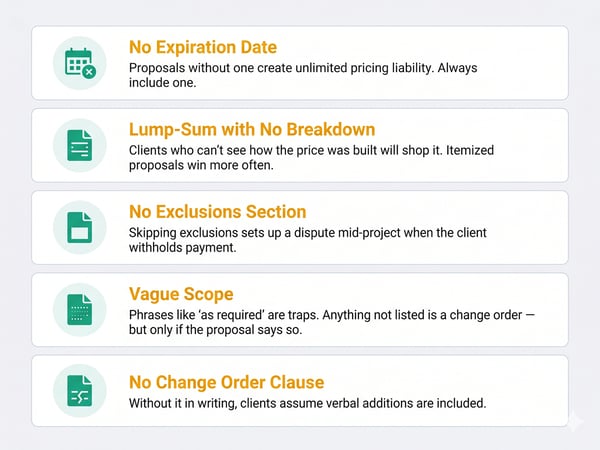
Mistake 1: No expiration date. Proposals without one create unlimited pricing liability. Always include one.
Mistake 2: Lump-sum with no breakdown. Clients who can't see how the price was built will shop it. Itemized proposals win more often — and at higher prices.
Mistake 3: No exclusions section. Skipping exclusions sets up a "you said you'd handle that" dispute mid-project when the client withholds payment.
Mistake 4: Vague scope ("all necessary work"). Phrases like "as required" are traps. Anything not listed is a change order — but only if the proposal says so.
Mistake 5: No change order clause. Without it in writing, clients assume verbal additions are included.
Relevant Article:Project Map It: The Contractor's Complete Guide to Mapping, Documenting & Managing Construction Projects in 2026
Frequently Asked Questions
How long should a construction proposal be?
2–5 pages for residential; 5–15 for commercial. The right length is however long it takes to fully define scope, pricing, and terms. A 1-page proposal that creates a dispute costs more than a 5-page one that doesn't.
Should a proposal include the full contract terms?
Yes, if you're using it as the signed agreement. Many contractors combine proposal + contract into one document. Ensure the terms don't conflict if you send them separately.
How do I handle allowances in a proposal?
Define them explicitly. Write: "Tile allowance: $8/SF installed. Selections above this allowance billed as a change order at cost." Undefined allowances are routinely misunderstood.
What's the difference between a proposal and a construction quote?
A quote is a single number; a proposal is a full document. For any project over $5,000, a full written proposal protects both parties. Many states require written contracts above $500–$1,000 — a signed proposal satisfies this if it includes required terms.
Conclusion
A strong construction proposal is the clearest signal to a client that you're professional, organized, and ready to execute — and your primary protection against scope disputes, payment delays, and change order arguments.
Use the 9-section structure, customize the template for your trade, and make it standard practice to send a complete proposal within 48–72 hours of every site visit. Contractors who win more jobs at higher prices aren't always the cheapest. They're the ones who make it easiest to say yes.
For the full document suite — see our how to estimate construction costs guide, construction contract template, construction change order template, and contractor invoice template.
Sources: Construction Industry Institute · NAHB Remodeling Market Survey 2025 · AGC Contractor Business Survey 2024


.jpg?height=200&name=1%20(89).jpg)