
Construction timesheets are the financial foundation of your business. Every payroll dollar, every...
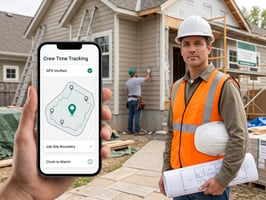
.jpg?width=1620&height=1215&name=2%20(68).jpg) A GPS timesheet does two things a paper timesheet cannot: it records when a worker clocked in and where they were standing when they did it. For construction, that distinction matters more than in almost any other industry. Workers split across multiple job sites, subcontractors billing by the hour, certified payroll requirements, prevailing wage audits, workers' comp claims — every one of these scenarios is easier to defend and cheaper to manage when the time record includes GPS coordinates, not just a worker's handwritten signature.
A GPS timesheet does two things a paper timesheet cannot: it records when a worker clocked in and where they were standing when they did it. For construction, that distinction matters more than in almost any other industry. Workers split across multiple job sites, subcontractors billing by the hour, certified payroll requirements, prevailing wage audits, workers' comp claims — every one of these scenarios is easier to defend and cheaper to manage when the time record includes GPS coordinates, not just a worker's handwritten signature.
The shift from paper timesheets to GPS time tracking is happening across the industry because contractors are getting burned. Workers clocking in from the parking lot before they've picked up a tool. Buddy punching on shared paper sign-in sheets. Payroll disputes where the superintendent swears someone left at 2pm and the worker insists it was 4pm. GPS timesheets resolve all of these at the source — not after the dispute has already cost time and money to investigate.
This guide covers what GPS timesheets are, how they work in construction, what to look for when choosing a system, and what switching from paper actually looks like in practice.
GPS Timesheets vs. Paper Timesheets: The Difference Is Defensibility
.jpg?width=600&height=450&name=3%20(96).jpg)
Paper timesheets are promises. GPS timesheets are records. A paper timesheet says "I was here from 7am to 4pm" and is signed by the worker and sometimes countersigned by a foreman. A GPS timesheet says the same thing, adds the GPS coordinates where the clock-in occurred, and stores both in a system the superintendent, PM, and payroll team can access without anyone emailing a spreadsheet or hunting down a paper sign-in sheet from three weeks ago.
The gap shows up in three situations:
Workers' comp claims. A worker files a claim for an injury that allegedly occurred on a job site. The employer's insurer wants to verify the worker was on that site that day. GPS timesheet: pull the record, confirm location, confirm hours. Paper timesheet: hope the sign-in sheet from that day is still in the trailer.
Prevailing wage and certified payroll audits. Federal and state prevailing wage requirements (Davis-Bacon and state equivalents) require certified payroll records that document hours by classification, by day. GPS-verified time records show the hours are real and the classification matches the work performed at that location. An audit of paper records requires reconstructing weeks of time data from handwritten sheets — if they still exist.
Labor disputes. A worker claims they weren't paid for all hours worked. GPS time records show exactly when they clocked in and out, where they were, and what cost code was active. Paper records invite a "he said / she said" investigation that typically ends with the contractor paying to avoid the fight.
How GPS Timesheets Work in Construction
Modern GPS timesheets are mobile-first: workers clock in from their phones, the app captures GPS coordinates at clock-in, and the record is stored in the cloud. The PM and superintendent see the records in real time. Payroll pulls the data at the end of the week without chasing anyone down.
The core workflow:
Worker opens the construction time tracking app on their phone
No special hardware. The app uses the phone's GPS — same GPS that powers Google Maps. Works on iOS and Android.
The app stamps the clock-in with the GPS coordinates at that moment. The worker selected a cost code — concrete formwork, framing, electrical rough-in — so the time is attributed to a specific scope of work, not just "labor."
The superintendent can see in real time who is clocked in, where they clocked in from, and how long they've been on the clock. If someone clocked in from a coffee shop three miles from the site, that shows up immediately.
GPS coordinates captured at clock-out. If a worker left an hour before they said they did, the record shows it.
At the end of the week, payroll pulls the GPS-verified hours by worker, by project, by cost code. No manual entry. No reconciliation of paper sheets against punch cards. The data is what it is.
Geofencing: GPS Timesheets That Enforce Site Boundaries
The next step beyond GPS verification is geofencing — setting a digital boundary around the job site so workers can only clock in when they're physically inside the fence. A geofenced construction time clock prevents off-site clock-ins entirely, rather than just flagging them after the fact.
How it works:
- The superintendent or PM draws a boundary around the job site in the app — typically a polygon or radius around the site center
- When a worker tries to clock in, the app checks their GPS location against the geofence
- If they're inside the boundary, the clock-in goes through
- If they're outside, the clock-in is blocked — the worker gets a message that they need to be on site
For multi-building projects or sites that span multiple blocks, modern GPS time tracking software supports multiple geofence zones within a single project. A worker on the east building clocks into the east building zone. A worker on the west building clocks into the west building zone. The time data is segmented even though it's the same project number.
Geofencing is particularly valuable for:
- Prevailing wage projects where the location of work affects the wage classification
- Occupied buildings where non-trade workers shouldn't be clocking time they're not earning
- Large sites with multiple crews who need to be tracked by zone
- Subcontractors whose billing is by verified hours on your site
What GPS Timesheets Capture That Paper Never Can
Beyond clock-in and clock-out, GPS construction timesheet software captures data that becomes useful for project management, job costing, and legal defense. None of it requires any additional action from the worker or supervisor — it's captured automatically.
Location at every clock event. Not just clock-in — some systems capture location at clock-out and during breaks as well. For workers who move between sites in a single day, each transition is recorded.
Cost code attribution. Every hour is tied to a cost code at the time it's recorded. At the end of the project, the construction timesheet app can produce a breakdown of total hours by cost code — concrete: 847 hours, framing: 1,203 hours, MEP rough: 631 hours. That data feeds directly into job cost reports and informs future estimates.
Device and user identity. Each clock-in is tied to a specific worker's account on a specific device. Buddy punching — one worker clocking in for another — is prevented because the GPS location and device ID don't match.
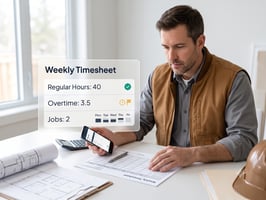
Overtime tracking. GPS timesheet software tracks daily and weekly hours in real time, flagging when workers are approaching overtime thresholds before overtime starts. Supervisors can adjust scheduling proactively rather than discovering expensive overtime in payroll.
Certified payroll records. For prevailing wage projects, GPS-verified time data exports into certified payroll format — the GPS coordinates confirm the workers were performing covered work at the covered location.
GPS Timesheets for Subcontractors
Subcontractors present a specific GPS timesheet challenge: their time records are the basis for T&M billing, but the GC has limited visibility into whether those records are accurate. A subcontractor who bills 200 hours of T&M work on a month where the project calendar only had 18 working days is billing roughly 11 hours per worker per day — which may or may not be accurate, and paper timesheets won't resolve the question.
When GCs require subcontractors to use GPS-verified time tracking:
T&M invoices are defensible. The GPS record shows each sub worker was on site for the hours billed. The GC can verify without a confrontation or an audit.
Scope boundary disputes shrink. When both the GC's workers and the sub's workers are tracked by GPS and cost code, it's clear who did what, when, and for how long. Disputes about scope overlaps have a factual record behind them.
Sub workers become part of the site safety record. If an incident occurs, GPS time records show exactly who was on site and when — including sub workers, not just GC direct hires.
For subcontractors using time tracking for construction workers on their own, the benefit runs the other direction: their GPS-verified time records protect them against GC claims that they billed hours they didn't work.
GPS Timesheets and Certified Payroll: The Compliance Angle
Every Davis-Bacon and state prevailing wage project requires certified payroll — weekly documentation that every worker was paid the required wage for the classification of work performed. GPS timesheets make certified payroll audits survivable in a way paper timesheets do not.
The compliance connection:
Location verification. The prevailing wage rate is determined by the location of the work and the classification of the worker. GPS time records prove the worker was performing covered work at the covered location on the days certified.
Classification accuracy. GPS timesheet software that captures cost codes verifies that the worker's time is attributed to the correct classification of work. An electrician clocking into "electrical rough-in" cost codes with GPS verification on a federal project has a complete record for wage compliance purposes.
Audit response. A prevailing wage audit requests certified payroll records for specific weeks and specific workers. GPS-verified digital records retrieve instantly. Paper records from 18 months ago may or may not still exist in the format the auditor requires.
Retroactive reconstruction is a losing game. Paper timesheets get lost, altered, or completed from memory rather than contemporaneously. Digital GPS records are timestamped at the moment of the event — not filled in at the end of the week from notes.
For projects with certified payroll requirements, see also construction bonds guide and how to negotiate a construction contract — both certified payroll obligations and compliance requirements should be reviewed and documented at contract execution, not discovered during construction.
The Job Costing Benefit: GPS Timesheets as a Financial Tool
GPS timesheets aren't just a time-capture mechanism — they're the primary data source for construction job costing. Every hour tracked with a cost code is a data point that tells you whether the project is running on budget for labor.
How it flows:
- Estimate establishes budgeted hours by cost code — concrete formwork: 800 hours at $45/hr = $36,000 budgeted
- Workers clock in against the concrete formwork cost code throughout the job
- GPS timesheet software accumulates actual hours in real time
- Job cost report compares actual hours to budgeted hours — 650 hours used with 40% of the work complete means labor is tracking ahead of budget
- PM adjusts crew size or schedule before the overrun becomes unrecoverable
Without GPS timesheets, this analysis requires someone to manually collect paper timesheets, enter them into a spreadsheet, and attribute each entry to the correct cost code — a process that typically runs 2–4 weeks behind actual field conditions. By the time the overrun is visible on paper, it's too late to correct.
For more on how labor tracking feeds into financial reporting, see construction WIP report and contractor profit and loss statement.
What to Look For in a GPS Timesheet System for Construction
.jpg?width=600&height=450&name=3%20(97).jpg)
Not all GPS timesheet apps are built for construction. A system designed for an office workforce looks nothing like what a field superintendent needs. The feature gaps show up immediately.
Must-have features for construction GPS timesheets:
Mobile clock-in with GPS capture
Workers clock in from their phones. GPS coordinates captured automatically at each clock event. No additional hardware, no card readers, no kiosks.
Cost code selection at clock-in
Every clock-in includes a cost code selection. The worker picks from a list of codes active for that project. Time is attributed to scope at the point of capture, not reconstructed afterward.
Geofencing support
Ability to set a site boundary and restrict clock-ins to workers within the boundary. Multi-zone support for large or complex sites.
Real-time visibility for superintendents
The superintendent can see who's clocked in right now, from where, and on what cost code — without calling anyone or waiting for a report.
Foreman clock-in for crews without smartphones
Some workers don't have smartphones or don't want to use personal devices for work. A construction-grade system allows foremen to clock in crew members on behalf of the crew, with GPS verification at the foreman's location.
Payroll export
Direct export to payroll systems — ADP, Paychex, QuickBooks — without manual data entry. The GPS-verified hours flow directly into payroll processing.
Certified payroll support
For prevailing wage projects, the system generates or exports certified payroll reports in the required format with the GPS-verified time data.
Offline mode
Construction sites don't always have reliable cell coverage. A GPS timesheet system for construction must function in offline mode — capturing time and location locally and syncing when connectivity returns.
The top 5 time tracking apps for construction covers the current field. For a direct comparison of the leading GPS time tracking options, see TaskTag vs. BusyBusy and top 5 BusyBusy alternatives.
GPS Timesheets for Landscaping and Outdoor Crews
The GPS timesheet use case extends beyond vertical construction to any crew that works across multiple locations. Landscaping maintenance crews servicing 12 properties in a day, irrigation contractors moving between residential sites, tree service crews dispatched from a central yard to job sites across a metro area — all have the same core problem: distributed workers, location-based billing, and no reliable way to verify which crew was where and for how long.
For landscaping crews, GPS timesheets resolve:
- Per-property billing accuracy — hours per site are GPS-verified, not estimated
- Route optimization — time records show actual time on each property, identifying inefficient routes
- Customer disputes — "your crew was only here for 20 minutes" is answered with a GPS record showing 47 minutes on-site
See time tracking for landscapers for landscaping-specific GPS timesheet implementation.
Making the Switch: What Moving from Paper to GPS Timesheets Looks Like
The biggest obstacle to switching isn't cost or complexity — it's getting every worker to actually use the app from day one. Rollouts that start with "we're going to try this" fail. Rollouts that start with "this is how time is recorded starting Monday" succeed.
Week 1 — Setup:
- Create the company account and add all projects
- Load cost codes for each active job
- Set up geofences for each site
- Add all workers and send them login credentials
- If any workers don't have smartphones, identify which foremen will clock in on their behalf
Day 1 — Supervised first clock-in:
The superintendent or foreman walks every worker through the first clock-in before work starts. Not a training session, not a video — an actual clock-in, supervised, on site. Workers see it's expected and see it works.
First week — Daily review:
Superintendent reviews the GPS time records at end of each day. Any worker who didn't clock in correctly gets a conversation the next morning before work starts. Errors corrected in the first week become non-issues by week two.
After 30 days:
The GPS timesheet data starts replacing weekly timesheet reconciliation. Payroll exports directly from the system. Job cost reports pull actual hours automatically. The manual time collection process is gone.
For subcontractors or crews with high turnover, the construction time tracking software onboarding process should mirror the above — new workers enrolled on their first day, first clock-in supervised, cost codes explained before they start.
GPS Timesheet Frequently Asked Questions
Do workers have to use their personal phones?
Most GPS timesheet systems run on iOS and Android and use the worker's personal device. Some contractors provide company phones for field workers. Some systems allow foreman clock-in where a single foreman's device handles the whole crew — useful for workers without smartphones.
What if there's no cell service on site?
Construction-grade GPS timesheet apps run in offline mode. Time and location are captured locally on the device and synced when the device reconnects. Work in a tunnel, basement, or remote site and the data is still there.
Can workers see their own GPS records?
Most systems give workers access to their own time records. This transparency reduces disputes because workers can verify their own hours before payroll is processed.
What about privacy concerns?
GPS tracking is active during work hours when the worker is clocked in. Most construction GPS timesheet systems stop tracking as soon as the worker clocks out — no after-hours location data is collected. Communicate this to workers at onboarding.
Does GPS timesheet data hold up in legal disputes?
Timestamped digital records with GPS coordinates are generally treated as more reliable than handwritten paper timesheets in labor disputes, workers' comp claims, and prevailing wage audits. Consult your legal counsel for jurisdiction-specific guidance.
What about certified payroll compliance?
GPS-verified time data is generally compatible with certified payroll reporting. Systems that capture both hours and location support the documentation requirements for Davis-Bacon and state prevailing wage projects.
Related Resources
TaskTag Features
- GPS Time Tracking for Construction — GPS timesheets, geofencing, and real-time crew visibility
- Construction Time Tracking Software — full platform overview for construction crews
- Time Tracking for Construction Workers — field crew setup and daily workflow
- Top 5 Construction Time Tracking Apps — current comparison of GPS timesheet options
- Top 5 BusyBusy Alternatives — GPS timesheet alternatives comparison
- TaskTag vs. BusyBusy — head-to-head GPS timesheet comparison
- Time Tracking for Landscapers — GPS timesheets for outdoor crews
Related Blog Posts
- Construction WIP Report — how GPS timesheet data feeds WIP reporting
- Contractor Profit and Loss Statement — labor cost tracking from GPS timesheets
- Construction Cash Flow Management — payroll outflow projections from GPS-verified hours
- Construction Retainage — certified payroll compliance on retainage-held projects
- How to Negotiate a Construction Contract — certified payroll obligations at contract review
- Construction Bonds Guide — prevailing wage and compliance requirements on bonded projects
- Construction Project Closeout — GPS time records as closeout documentation