

.jpg?height=200&name=2%20(59).jpg)
More than 60% of construction businesses fail within the first five years — not because the owner...

There are over 3.7 million licensed contractors in the United States — and an unknown number operating without the licenses their state requires. Operating without a required license exposes you to fines up to $10,000 per violation, contract voidability (meaning the owner may not have to pay), criminal charges in some states, and loss of the ability to file a mechanics lien.
How Contractor Licensing Is Structured
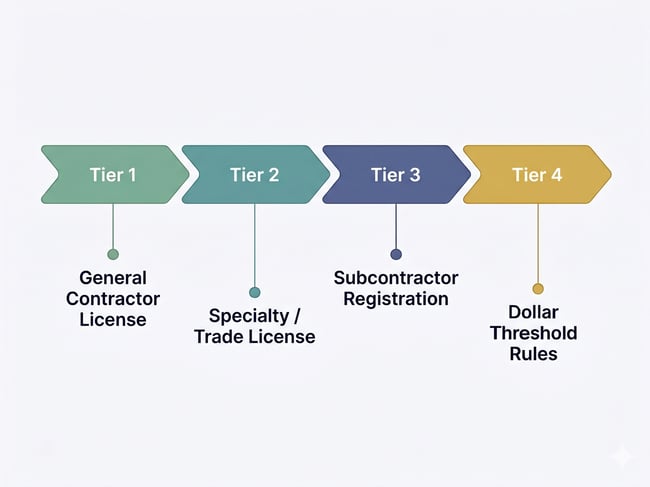
Tier 1 — General Contractor (GC) License — authorizes you to perform general construction, manage subs, pull permits. Many states split into residential and commercial.
Tier 2 — Specialty/Trade License — required for electrical, plumbing, HVAC, roofing, fire suppression regardless of GC status.
Tier 3 — Subcontractor Registration — lower bar than licensing; usually just insurance certificate + application fee.
Dollar thresholds: Many states only require a license for projects above a value ($500, $1,000, $10,000+). Exemptions are narrow — never assume.
State-by-State Requirements (All 50 States)
Alabama — Projects over $50K residential / $10K commercial. Exam required. $100K GL min. No reciprocity.
Alaska — Any construction work. Exam required. $100K GL min.
Arizona — Projects over $1,000. 60+ license classifications. Exam required. $1K–$15K surety bond.
Arkansas — Projects over $20,000. Exam required. $100K–$1M GL.
California — Projects over $500. 44 classifications. Exam required. $15K bond. No reciprocity. Unlicensed work above $500 is a misdemeanor.
Colorado — No statewide license. Local only. Denver, Colorado Springs, Aurora have active programs.
Connecticut — Home improvement over $200. $500K GL min. Exam required.
Delaware — Primarily local licensing. Check your county.
Florida — Any contracting work. $300K GL (residential) / $1M (commercial). Workers' comp required for 1+ employee. Certified (statewide) vs. Registered (county) structure.
Georgia — Residential projects over $2,500. No statewide commercial GC license required.
Hawaii — Any contracting work. Exam required. Bond + GL required.
Idaho — Projects over $2,000. No exam — registration + insurance only.
Illinois — No statewide GC license. Local only. Chicago requires $1M GL. Roofing licensed statewide.
Indiana — No statewide GC license. Trades licensed at state level.
Iowa — Contractors employing 1+ workers must register. No exam.
Kansas — No statewide GC license. Local only.
Kentucky — Projects over $10,000. Exam required. $100K GL min.
Louisiana — Projects over $50,000. Financial statement review + exam. Active enforcement.
Maine — Residential construction. Exam required. $300K GL min.
Maryland — All home improvement work. $50K–$100K GL; $20K surety bond.
Massachusetts — Home improvement over $1,000. Construction Supervisor License (CSL) required for any structural work. $1M GL min.
Michigan — Residential building + specialty trades. $100K–$500K GL.
Minnesota — Residential contractors and remodelers. $100K GL min. Commercial work exempt.
Mississippi — Projects over $50,000. Exam required.
Missouri — No statewide GC license. Local only. St. Louis and Kansas City have robust programs.
Montana — Any construction employing 1+ workers. Registration-based. No exam.
Nebraska — No statewide GC license. Local only.
Nevada — Projects over $1,000. Exam required. $500K GL min. Active enforcement.
New Hampshire — Home improvement over $1,000. $500K GL; workers' comp required.
New Jersey — All home improvement. Home Improvement Contractor (HIC) registration. $500K GL min.
New Mexico — Any construction work. Exam required. $50K bond min.
New York — No statewide GC license. Local only. NYC has one of the most complex licensing systems in the country. Trades licensed at state level.
North Carolina — Projects over $30,000. Exam required. Limited / Intermediate / Unlimited classifications.
North Dakota — Any contracting work. No exam — registration-based. $100K GL.
Ohio — No statewide GC license. Local only. Trades licensed at state level.
Oklahoma — Projects over $10,000. Exam required. $50K–$500K GL.
Oregon — Projects over $500. Exam required. $500K–$2M GL. No reciprocity.
Pennsylvania — No statewide GC license. HIC registration statewide for home improvement. $50K GL.
Rhode Island — Any construction work. Exam required. $400K GL min.
South Carolina — Projects over $5,000. Exam required. $100K GL min.
South Dakota — Trades licensed at state level. GC primarily local.
Tennessee — Projects over $25,000. Exam required. $10K surety bond.
Texas — No statewide GC license. Local only. Electrical, plumbing, HVAC licensed at state level.
Utah — Projects over $3,000. Exam required. $200K GL min.
Vermont — Residential and commercial. Exam required. $1M GL min.
Virginia — Projects over $1,000. Exam required. Class A / B / C structure. $50K–$500K GL.
Washington — Projects over $500. No exam — registration only. $200K GL; $12K surety bond.
West Virginia — Projects over $2,500. Exam required. $100K GL.
Wisconsin — Dwelling contractor license for residential. Exam required. $100K GL.
Wyoming — No statewide GC license. Local only. Minimal requirements.
States With No Statewide GC License
|
State |
Notes |
|
Colorado |
Denver, Colorado Springs, Aurora have active programs |
|
Illinois |
Chicago robust; statewide only for roofing |
|
Indiana |
Local dominant; trades at state level |
|
Kansas |
Kansas City, Wichita have local requirements |
|
Missouri |
St. Louis and Kansas City programs |
|
Nebraska |
Omaha and Lincoln active; rest minimal |
|
New York |
NYC is one of the most complex in the US |
|
Ohio |
Columbus, Cleveland, Cincinnati each separate |
|
Pennsylvania |
Local; HIC registration statewide |
|
Texas |
No statewide GC; local only; trades at state level |
|
Wyoming |
Local only; minimal requirements |
Reciprocity: What Actually Transfers
[SVG table: Reciprocity agreements — Alabama/Arkansas/Louisiana with Gulf states (exam waiver only); NC/VA case-by-case; California/Florida/Oregon — no reciprocity]
Bottom line: Even where reciprocity exists, it means your exam score transfers — not your license. You still apply, pay fees, and meet the new state's insurance requirements.
What Every Application Needs
[SVG checklist: Application form + fee, exam scores, GL certificate, workers' comp certificate, surety bond, business entity docs, EIN, experience documentation, references, financial statement for higher classifications]
Processing times: 1–2 weeks (Washington) → 3–6 months (New York City).
Operating Without a License: The Real Risks
- Fines: $500–$10,000 per violation; some states fine per day
- Contract voidability: In CA, FL, and others — owner may legally refuse to pay
- Lien rights lost: Unlicensed contractors can't file mechanics liens in most states
- Criminal liability: CA, NV, AZ treat repeat unlicensed contracting as misdemeanor or felony
- Insurance claims denied: GL insurer may deny claims if you weren't properly licensed
License Maintenance After Approval
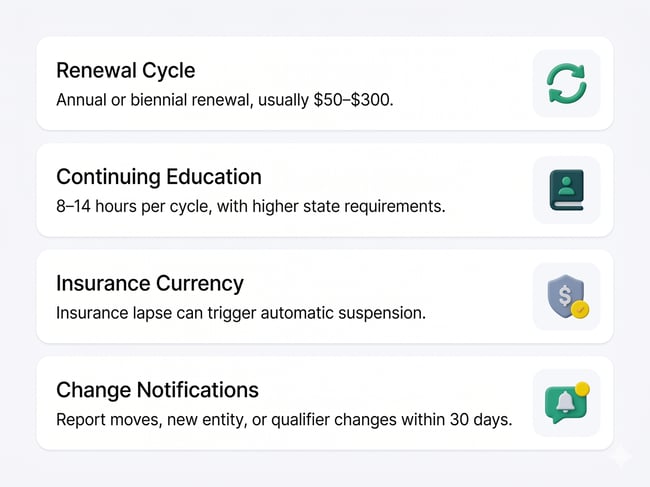
- Renewal: Annual or biennial; $50–$300
- Continuing education: 8–14 hours per cycle (CA requires 32 hours)
- Insurance currency: Lapse triggers automatic suspension in most states
- Change notifications: Moving, new entity, or new qualifier — notify board within 30 days
Relevant Article:Track Subcontractor Compliance (COIs, Licenses)
Related Resources
- How to Start a Construction Business
- Construction Contract Template — license number required on every contract
- How to Manage Subcontractors — verify sub licenses before they step on site
- Construction Subcontractor Agreement Template — require license verification in every sub agreement
- How to Grow a Construction Business