

Contractors without a written contract are 3x more likely to face a payment dispute than those with a signed agreement (Levelset, 2023). Yet 25–30% of small contractors still rely on verbal agreements. One disputed job can wipe out months of profit — and without a contract, you have almost no legal recourse.
Key Takeaways
- Contractors without written contracts are 3x more likely to face payment disputes (Levelset, 2023)
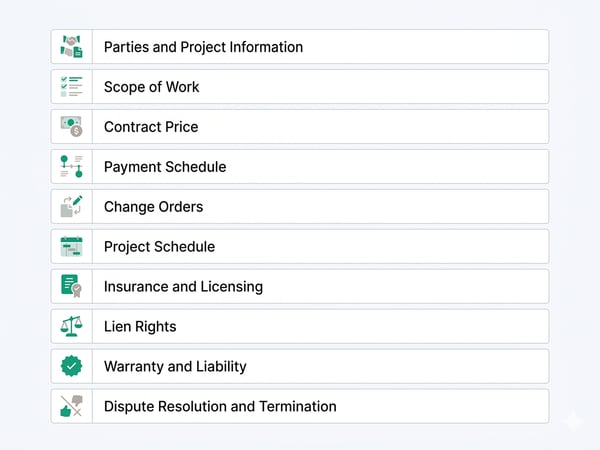
- A complete construction contract has 10 core clauses: scope, price, payment schedule, change orders, timeline, insurance, lien rights, dispute resolution, termination, and warranty
- Change order clauses are the single highest-value addition — undocumented scope changes are the #1 source of contractor losses
- Always have a local attorney review before first use — state lien and licensing laws vary significantly
Why Every Contractor Needs a Written Contract
A verbal agreement is legally enforceable in most states — but almost impossible to prove. When a client says "we agreed on $15,000" and you say "$18,500," the party with documentation wins.
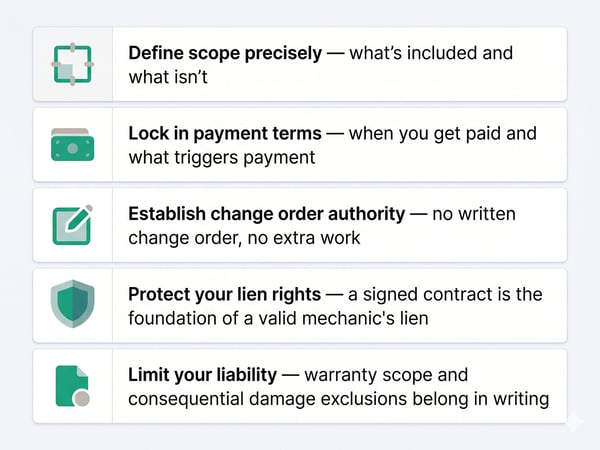
Construction contracts do five things verbal agreements can't:
- Define scope precisely — what's included and what isn't
- Lock in payment terms — when you get paid and what triggers payment
- Establish change order authority — no written change order, no extra work
- Protect your lien rights — a signed contract is the foundation of a valid mechanic's lien
- Limit your liability — warranty scope and consequential damage exclusions belong in writing
Our finding: The most expensive clause contractors skip isn't the payment schedule — it's the change order clause. Undocumented scope additions represent the single largest source of unrecovered contractor revenue. "No work outside original scope begins without a signed written change order" protects more money than any other single provision.
See our house renovation business plan guide for how contracts fit into your broader project management and operations framework.
Construction Contract Template: All 10 Clauses
Clause 1: Parties and Project Information
CONSTRUCTION CONTRACT
Date: _______________
Contractor: [Business Name] License #: [License Number]
Address: [Address]
Owner/Client: [Client Full Name]
Address: [Client Address]
Project Address: [Job Site Address]
Project Description: [One-sentence summary]
Always include your contractor license number. In most states, a contract for licensed work without it is unenforceable.
Clause 2: Scope of Work
SCOPE OF WORK
Contractor agrees to perform the following work:
[Detailed description]
The scope includes:
- [Item 1]
- [Item 2]
The scope expressly excludes:
- [e.g., landscaping restoration]
- [e.g., permit fees above $X]
- [e.g., work behind walls not visible during initial inspection]
All work performed in a workmanlike manner per applicable building codes.
The exclusions list is as important as the inclusions. Every experienced contractor has a story about a client who assumed something was included. Write exclusions explicitly.
Clause 3: Contract Price
CONTRACT PRICE
Owner agrees to pay: $[TOTAL AMOUNT]
Based on assumptions:
- [e.g., existing framing is sound and up to code]
- [e.g., no hazardous materials present]
If material conditions differ, Contractor notifies Owner in writing
and parties negotiate an adjustment via Change Order before proceeding.
☐ Fixed price (lump sum): $___________
☐ Time and materials: Labor $___/hr + materials at cost + ___% markup
☐ Cost plus fixed fee: Costs + $___________
Clause 4: Payment Schedule
PAYMENT SCHEDULE
- Deposit (contract signing): $_______ (___%)
- Phase 1 — [Milestone]: $_______ (___%)
- Phase 2 — [Milestone]: $_______ (___%)
- Substantial completion: $_______ (___%)
- Final (punch list complete): $_______ (___%)
TOTAL: $_______
- Each payment due within [10/15] days of milestone completion
- Late balances accrue 1.5%/month interest
- Contractor may suspend work if any payment is >5 days late
- Final payment due upon Owner's written punch list sign-off
Never start the next phase without collecting the prior payment. For milestone invoices that tie to this schedule, see our contractor invoice template.
Clause 5: Change Orders
CHANGE ORDERS
Any work outside the Scope of Work requires a written Change Order
signed by both parties BEFORE work begins.
Each Change Order specifies:
- Description of additional work
- Adjusted Contract Price
- Schedule impact (if any)
Contractor is not obligated to perform work without a signed Change Order.
Verbal direction from Owner does not constitute authorization.
Emergency work may proceed verbally, followed by written Change Order
within 24 hours.
Daily reports are your documentation backbone for change order disputes. See our construction daily report template — logging all verbal requests in your daily log is your strongest evidence.
Clause 6: Project Schedule
PROJECT SCHEDULE
Estimated start: ___________
Estimated completion: ___________
Contractor not liable for delays caused by:
- Weather or acts of God
- Owner-caused delays (late decisions, restricted access)
- Subcontractor delays beyond Contractor's control
- Material shortages or supply chain disruptions
- Unforeseen site conditions
Owner shall provide reasonable site access (7am–5pm, Mon–Fri).
Time is NOT of the essence.
"Time is not of the essence" is critical. Without it, a missed completion date can be treated as a material breach — even for a minor delay.
Clause 7: Insurance and Licensing
INSURANCE
Contractor maintains:
- CGL: min $1,000,000 per occurrence / $2,000,000 aggregate
- Workers' Compensation: per state law
Certificates available upon request.
LICENSING
Contractor holds all licenses required by state/county law.
License #: ___________
Clause 8: Lien Rights
LIEN RIGHTS
Contractor and its subcontractors have lien rights under state law.
Non-payment may result in a mechanic's lien against the property.
Contractor provides lien releases upon receipt of each payment.
A mechanic's lien clouds the property title, preventing sale or refinancing until resolved. For the lien notice language to include on every invoice, see our contractor invoice template.
Clause 9: Warranty and Liability
WARRANTY
Workmanship warranted against defects for [1/2] year(s) from
substantial completion.
Excludes:
- Normal wear and tear
- Owner misuse, modification, or neglect
- Acts of God
- Owner-supplied materials
- Pre-existing conditions
LIMITATION OF LIABILITY
Contractor's liability shall not exceed the total Contract Price.
No liability for consequential, incidental, or punitive damages.
Clause 10: Dispute Resolution and Termination
DISPUTE RESOLUTION
Good-faith negotiation first. If unresolved:
☐ Binding arbitration ☐ Mediation then litigation
☐ Litigation in [County, State] courts
Prevailing party recovers attorney's fees.
TERMINATION
Owner may terminate with 7 days written notice; owes all completed
work plus ___% termination fee.
Contractor may terminate if:
- Any payment is >10 days overdue
- Owner materially interferes with work
- Site conditions are unsafe
GOVERNING LAW: State of ___________
Copy-Ready Template
═══════════════════════════════════════════════════════
CONSTRUCTION CONTRACT
═══════════════════════════════════════════════════════
Date: _______________
PARTIES
Contractor: _______________________ License #: _______
Address: ________________________________________
Owner: _________________________________________
Project Address: _________________________________
- SCOPE OF WORK
Includes: _______________________________________
Excludes: _______________________________________
- CONTRACT PRICE $____________
☐ Fixed price ☐ Time & materials ☐ Cost plus
- PAYMENT SCHEDULE
Deposit: $_______ (___%)
Phase 1 — [milestone]: $_______ (___%)
Phase 2 — [milestone]: $_______ (___%)
Substantial completion: $_______ (___%)
Final (punch list): $_______ (___%)
Due within ___ days of each milestone. Late fee: 1.5%/mo.
- CHANGE ORDERS
No out-of-scope work begins without signed written Change Order.
- SCHEDULE
Start: _________ End: _________
Time is NOT of the essence. Delays beyond Contractor's control
extend schedule without penalty.
- INSURANCE CGL: $_______ per occurrence. WC per state law.
- LIEN RIGHTS Contractor reserves all mechanic's lien rights.
- WARRANTY ___ year(s) workmanship. Liability capped at
Contract Price. No consequential damages.
- DISPUTES ☐ Arbitration ☐ Mediation ☐ Litigation
[County, State]. Prevailing party recovers attorney's fees.
10. TERMINATION Owner: 7 days notice + ___% fee. Contractor:
for non-payment or unsafe conditions.
═══════════════════════════════════════════════════════
Contractor: _______________________ Date: ___________
Owner: ____________________________ Date: ___________
═══════════════════════════════════════════════════════
State-Specific Requirements to Check
Before using any contract template, verify for your state:
- Deposit caps (California: max 10% or $1,000 · Florida: max 10% for jobs under $2,500 · New Jersey: max 1/3 of contract)
- Written contract thresholds (California: required for jobs over $500)
- Required contract language (right to cancel, lien notice, license number)
- Preliminary notice requirements for lien rights preservation
- Home improvement contractor registration (NJ added mandatory GC licensing February 2026)
Relevant Article:Building Smarter: How Contractors Can Stay Organized and On Track
Frequently Asked Questions
Does a construction contract need to be notarized?
No — notarization is not required in any US state for construction contracts. A signed contract between two competent parties is legally binding. Notarization is only required for documents recorded with a county (like a deed or lien filing).
What happens if I start work without a signed contract?
You significantly weaken your legal position. Scope, price, and terms become whatever each party remembers. Courts rely on emails, texts, and invoices to reconstruct terms — and the client's documentation is usually better organized than yours. See our pressure washing contracts template for how the same contract principles apply across any trade.
How do I handle a client who wants changes after signing?
Changes to a signed contract must be documented as Change Orders or formal amendments. A verbal request after signing does not modify the contract. Document all verbal requests in your daily site log. See our construction daily report template for how to record these properly.
Should I use AIA contract forms instead?
AIA forms are industry-standard for commercial construction and widely recognized by lenders and courts. For residential and small commercial work they're often overkill — complex and formal beyond what most projects warrant. A well-drafted custom template reviewed by a local attorney is more practical.
What's the difference between fixed-price and time-and-materials contracts?
A fixed-price contract sets a single total — the contractor bears cost risk. A T&M contract bills actual hours plus materials — the owner bears cost risk. Most residential clients prefer fixed-price for budget certainty. T&M is more common when the full scope is unknown until work begins. See our construction punch list template for how the contract type affects your closeout process.
Conclusion
A construction contract defines your project, protects your payment, and limits your liability from day one. Contractors who use written contracts consistently collect faster, dispute less, and exit problem projects with legal recourse intact.
Use the template above, have a local attorney review it once for your state's requirements, and make signing it a non-negotiable step before any work begins.
For the full contractor documentation stack, see our contractor invoice template for milestone billing tied to your contract payment schedule, and our construction punch list template for the closeout process that triggers your final payment.
Sources: Levelset State of Contractor Payments 2023 · State contractor licensing board requirements · AIA contract guidelines 2025
.jpg?height=200&name=1%20(51).jpg)